


Product Description
by Federal Highway Administration (Author), U. S. Department of Transportation (Author)
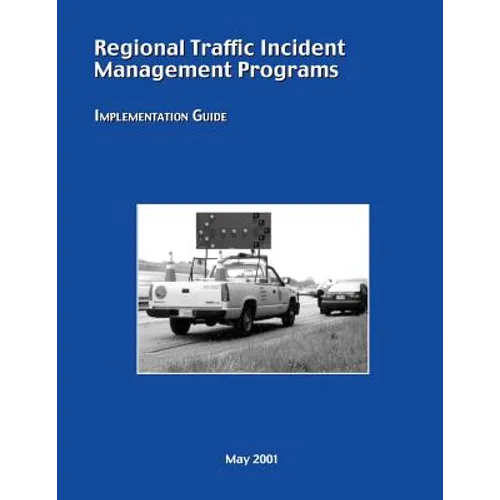
The purpose of this document is to assist organizations and their leaders in implementing and sustaining regional traffic incident management programs, both by examining some successful models, and by considering some of the lessons learned by early implementers. There is some form of incident management activity in most major and many mid-sized urban areas. Typically this involves each agency carrying out its own responsibilities, with primarily working-level and middle-management administrative teams to provide coordination with the other agencies who are also involved in their own aspects of managing incidents. Such a situation not only achieves less than the full potential benefit, but also leaves open many risks for failure within individual agencies or on a broader scale. The objective of this document is to present a framework for developing what is missing in almost every urban area-a formal multiagency traffic incident management program, with endorsement by, participation from, and coordination by senior agency management, and which includes all of the participating agencies. Formalizing the incident management effort-turning it into an incident management program-involves such steps as developing a written and endorsed strategy and a plan to implement the strategy; identifying and building support from a full complement of stakeholders and with the public; gaining support and ongoing participation in program direction from agency senior executives; documenting the respective roles and responsibilities of participants; establishing program goals and objectives and evaluating performance on these; establishing incident management as a major mission within and between the participating agencies; and "mainstreaming" of funding for incident management into the traditional transportation planning process.