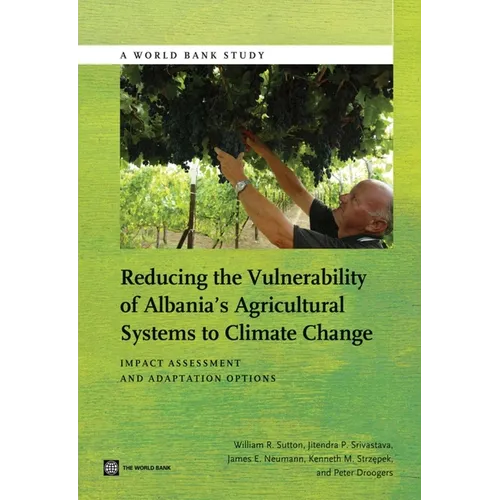
Product Description
by William R. Sutton (Author), Jitendra P. Srivastava (Author), James E. Neuman (Author)
"Agriculture is one of the most climate-sensitive of all economic sectors. In many countries, such as in Albania, the risks of climate change are an immediate and fundamental problem because the majority of the rural population depends either directly or indirectly on agriculture for their livelihoods. The risks of climate change to agriculture in Alabania cannot be effectively dealt with-and the opportunities cannot be effectively exploited-without a clear plan for aligning agricultural policies with climate change, developing the capabilities of key agricultural institutions, and making needed investments in infrastructure, support services and on-farm improvements. Developing such a plan ideally involves a combination of high-quality quantitative analysis, consultation with key stakeholders, particularly farmers and local agricultural experts, and investments in both human and physical capital. The experience of Albania, highlighted in this work, shows that it is possible to develop a plan to meet these objectives-one that is comprehensive and empirically driven as well as consultative and quick to develop. The approach of this study is predicated on strong country ownership and participation, and is defined by its emphasis on "win-win" or "no regrets" solutions to the multiple challenges posed by climate change for farmers in Albania. The solutions are measures that increase resilience to future climate change, boost current productivity despite the greater climate variability already occurring, and limit greenhouse gas emissions. Reducing The Vulnerability of Albania's Agricultural Systems to Climate Change: Impact Assessment and Adaptation Options applies this approach to Albania with the goal of helping the country mainstream climate change adaptation into its agricultural policies, programs, and investments. The study projects impacts of climate change on agriculture across Albania's three agro-ecological areas through forecast variations in temperature and rainfall patterns so crucial to farming. It offers a map for navigating the risks and realizing the opportunities, outlined through a series of consultations with local farmers. A detailed explanation of the approach is provided for those who would like to implement similar programs in other countries of Europe, Central Asia, or anywhere else in the world. This is one of four country studies that were produced under the World Bank's program, "Reducing Vulnerability to Climate Change in European and Central Asian Agricultural Systems". The other countries included in this series are FYR Macedonia, Moldova, and Uzbekistan. The results from the four studies are consolidated in the book Looking Beyond the Horizon: How Climate Change Impacts and Adaptation Responses Will Reshape Agriculture in Eastern Europe and Central Asia website."