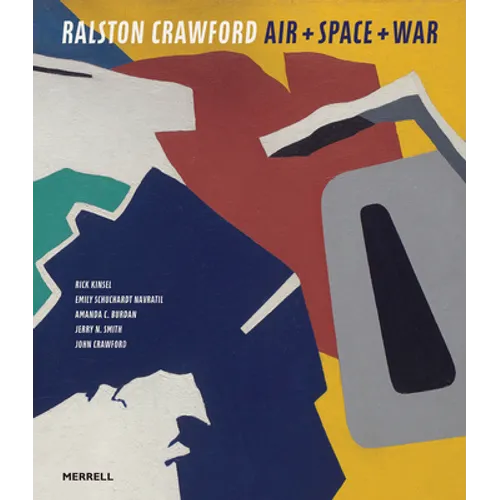
Product Description
by Rick Kinsel (Author), Emily Schuchardt Navratil (Author), Amanda C. Burdan (Author)
American art underwent a transformation during the period 1940-55, and nowhere is that change better exemplified than in the work of Ralston Crawford (1906-1978). Crawford worked in a variety of media throughout his career, and his wartime and early postwar art ranged from designing camouflage and creating weather infographics for the US Army to documenting the detonation of the atomic bomb for Fortune magazine. This exciting new book explores Crawford's influences and the ideas and experiences he had during World War II and its aftermath, and chronicles a period of change, during which Crawford gradually moved away from celebrating feats of engineering and industrial development to creating imagery that was more abstract and far more personal, expressing the grief and anxiety of the postwar world. Crawford's painting during the 1930s had largely been a dazzling series of Precisionist works that reflected American advances in industry, engineering and technology. After the United States entered World War II, Crawford served in the Weather Division of the Army Air Forces. He created pictorial representations of weather patterns for airplane pilots, and was exposed to countless photographs of air crashes. He continued working as an artist throughout the conflict, receiving a commission to paint the Curtiss-Wright aircraft plant in Buffalo, New York, and, in 1946, an assignment to observe and record one of the atomic bomb tests at Bikini Atoll. These experiences had a profound impact on Crawford, and marked a major turning point in his life and art. Published to coincide with an exhibition opening at the Dayton Art Institute, Ralston Crawford: Air & Space & War presents a remarkable selection of Crawford's paintings, drawings, photographs and prints from this time. These vary from powerful images of chaos and devastation to ordered and precise paintings of airplane assembly at the Curtiss-Wright plant and cover illustrations and charts related to weather, flight and radar for Fortune magazine. The evolution of many of the works can be traced from photograph and drawing to the finished painting, revealing Crawford's decisions about form and space, which were informed by his experiences with airplanes and flight. Accompanying the artworks is a series of perceptive essays. Rick Kinsel considers Crawford's war years in the context of developments in both aviation and American art. Emily Schuchardt Navratil reflects on aerial views by Crawford and on his Curtiss-Wright commission. Amanda Burdan looks at Crawford's work for Fortune, while Jerry Smith surveys various American and European abstract renditions of airplanes and flight as a means by which to place Crawford's interest in aviation during World War II into a broader historical context. In the final essay, John Crawford examines the importance of photography in his father's work, and explores collage as both a compositional technique and as a term that may be used to describe the series of intense experiences that contributed to Crawford's development as an artist in the 1940s and early 1950s.