


Product Description
by Atsuo Kuniba (Author)
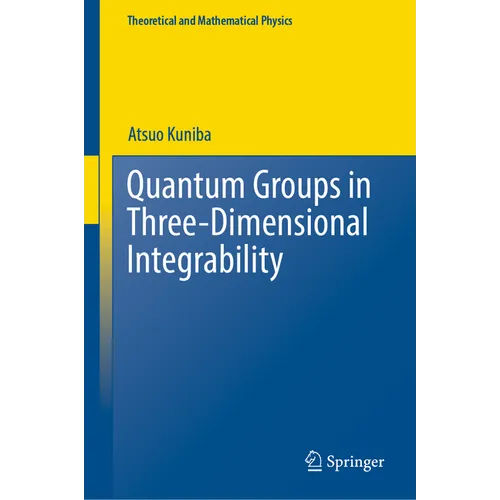
Quantum groups have been studied intensively in mathematics and have found many valuable applications in theoretical and mathematical physics since their discovery in the mid-1980s. Roughly speaking, there are two prototype examples of quantum groups, denoted by Uq and Aq. The former is a deformation of the universal enveloping algebra of a Kac-Moody Lie algebra, whereas the latter is a deformation of the coordinate ring of a Lie group. Although they are dual to each other in principle, most of the applications so far are based on Uq, and the main targets are solvable lattice models in 2-dimensions or quantum field theories in 1+1 dimensions. This book aims to present a unique approach to 3-dimensional integrability based on Aq. It starts from the tetrahedron equation, a 3-dimensional analogue of the Yang-Baxter equation, and its solution due to work by Kapranov-Voevodsky (1994). Then, it guides readers to its variety of generalizations, relations to quantum groups, and applications. They include a connection to the Poincaré-Birkhoff-Witt basis of a unipotent part of Uq, reductions to the solutions of the Yang-Baxter equation, reflection equation, G2 reflection equation, matrix product constructions of quantum R matrices and reflection K matrices, stationary measures of multi-species simple-exclusion processes, etc. These contents of the book are quite distinct from conventional approaches and will stimulate and enrich the theories of quantum groups and integrable systems.
Back Jacket
Quantum groups have been studied intensively in mathematics and have found many valuable applications in theoretical and mathematical physics since their discovery in the mid-1980s. Roughly speaking, there are two prototype examples of quantum groups, denoted by Uq and Aq. The former is a deformation of the universal enveloping algebra of a Kac-Moody Lie algebra, whereas the latter is a deformation of the coordinate ring of a Lie group. Although they are dual to each other in principle, most of the applications so far are based on Uq, and the main targets are solvable lattice models in 2-dimensions or quantum field theories in 1+1 dimensions. This book aims to present a unique approach to 3-dimensional integrability based on Aq. It starts from the tetrahedron equation, a 3-dimensional analogue of the Yang-Baxter equation, and its solution due to work byKapranov-Voevodsky (1994). Then, it guides readers to its variety of generalizations, relations to quantum groups, and applications. They include a connection to the Poincaré-Birkhoff-Witt basis of a unipotent part of Uq, reductions to the solutions of the Yang-Baxter equation, reflection equation, G2 reflection equation, matrix product constructions of quantum R matrices and reflection K matrices, stationary measures of multi-species simple-exclusion processes, etc. These contents of the book are quite distinct from conventional approaches and will stimulate and enrich the theories of quantum groups and integrable systems.