


Product Description
by José Unpingco (Author)
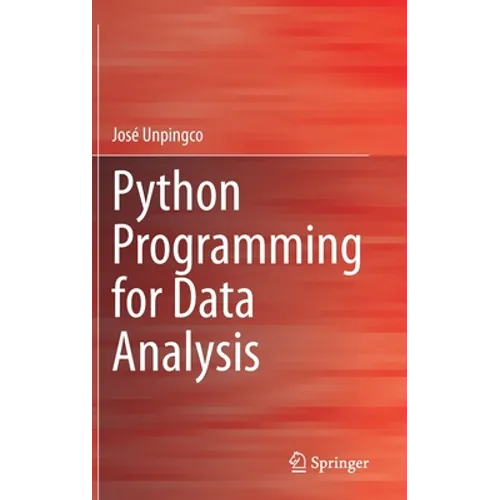
This textbook grew out of notes for the ECE143 Programming for Data Analysis class that the author has been teaching at University of California, San Diego, which is a requirement for both graduate and undergraduate degrees in Machine Learning and Data Science. This book is ideal for readers with some Python programming experience. The book covers key language concepts that must be understood to program effectively, especially for data analysis applications. Certain low-level language features are discussed in detail, especially Python memory management and data structures. Using Python effectively means taking advantage of its vast ecosystem. The book discusses Python package management and how to use third-party modules as well as how to structure your own Python modules. The section on object-oriented programming explains features of the language that facilitate common programming patterns.
After developing the key Python language features, the book moves on to third-party modules that are foundational for effective data analysis, starting with Numpy. The book develops key Numpy concepts and discusses internal Numpy array data structures and memory usage. Then, the author moves onto Pandas and details its many features for data processing and alignment. Because strong visualizations are important for communicating data analysis, key modules such as Matplotlib are developed in detail, along with web-based options such as Bokeh, Holoviews, Altair, and Plotly.
The text is sprinkled with many tricks-of-the-trade that help avoid common pitfalls. The author explains the internal logic embodied in the Python language so that readers can get into the Python mindset and make better design choices in their codes, which is especially helpful for newcomers to both Python and data analysis.To get the most out of this book, open a Python interpreter and type along with the many code samples.
Back Jacket
This textbook grew out of notes for the ECE143 Programming for Data Analysis class that the author has been teaching at University of California, San Diego, which is a requirement for both graduate and undergraduate degrees in Machine Learning and Data Science. This book is ideal for readers with some Python programming experience. The book covers key language concepts that must be understood to program effectively, especially for data analysis applications. Certain low-level language features are discussed in detail, especially Python memory management and data structures. Using Python effectively means taking advantage of its vast ecosystem. The book discusses Python package management and how to use third-party modules as well as how to structure your own Python modules. The section on object-oriented programming explains features of the language that facilitate common programming patterns.
After developing the key Python language features, the book moves on to third-party modules that are foundational for effective data analysis, starting with Numpy. The book develops key Numpy concepts and discusses internal Numpy array data structures and memory usage. Then, the author moves onto Pandas and details its many features for data processing and alignment. Because strong visualizations are important for communicating data analysis, key modules such as Matplotlib are developed in detail, along with web-based options such as Bokeh, Holoviews, Altair, and Plotly.
The text is sprinkled with many tricks-of-the-trade that help avoid common pitfalls. The author explains the internal logic embodied in the Python language so that readers can get into the Python mindset and make better design choices in their codes, which is especially helpful for newcomers to both Python and data analysis.To get the most out of this book, open a Python interpreter and type along with the many code samples.
Author Biography
Dr. José Unpingco completed his PhD from the University of California, San Diego (UCSD) in 1997 and has since worked in industry as an engineer, consultant, and instructor on a wide variety of advanced data science topics, with deep experience in machine learning. He was the onsite technical director for large-scale Signal and Image Processing for the Department of Defense (DoD) where he also spearheaded the DoD-wide adoption of scientific Python. Dr. Unpingco is currently the Senior Director for Data Science for the Gary and Mary West Health Institute, a non-profit Medical Research Organization in San Diego, California. He is also a Data Science lecturer at UCSD for undergraduate and graduate degree programs and the author of Python for Signal Processing, and Python for Probability, Statistics, and Machine Learning.