


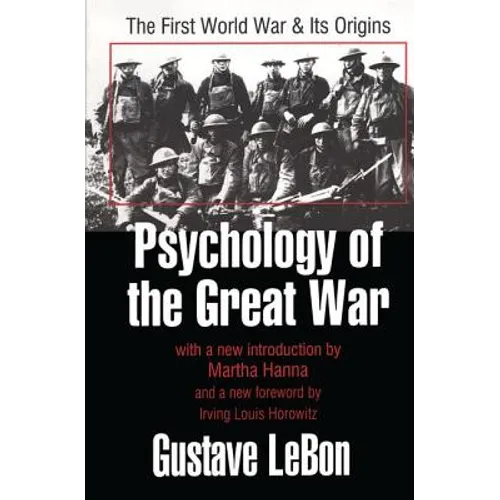
Product Description
by Gustave Le Bon (Editor)
The outbreak of World War I saw the collapse of socialist notions of class solidarity and reaffirmed the enduring strength of nationalism. The workers of the world did not unite, but turned on one another and slaughtered their fellows in what was then the bloodiest war in history. There have been many efforts to explain the outbreak of war in 1914, but few from so intimate a perspective as LeBon's. He examines such questions as why German scholars tried to deny Germany's obvious guilt in the war, and what explained the remarkable resolve of the French army to persevere in the face of unprecedented adversity.
To such questions, LeBon proposes answers built upon principles well articulated in the larger body of his work. He transforms the character of the debate by demonstrating how psychological principles explain more persuasively both the causes of German academic ignominy and the origins of French valor. Convinced as he was that only psychology could illuminate collective behavior, LeBon dismisses purely economic or political interpretations as ill-conceived and inadequate precisely because they fail to appreciate the role of psychology in the collective behavior of national statesmen, prominent scholars, and ordinary soldiers.
The Psychology of the Great War provides a bridge to study both crowd behavior and battlefield behavior by illustrating how ordinary people are transformed into savages by great events. This element in LeBon's thinking influenced Georges Sorel's thinking, as he had seen the same phenomenon in those who participated in general strikes and revolutions. And in a later period and different context, Hannah Arendt gave this strange capacity of the ordinary to be transformed into the extraordinary the name "banality of evil." The book will be of interest to social theorists, psychologists concerned with group behavior, and historians of the period.



