


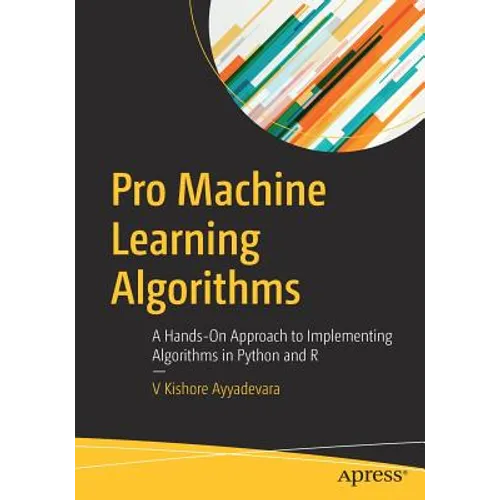
Product Description
by V. Kishore Ayyadevara (Author)
Bridge the gap between a high-level understanding of how an algorithm works and knowing the nuts and bolts to tune your models better. This book will give you the confidence and skills when developing all the major machine learning models. In Pro Machine Learning Algorithms, you will first develop the algorithm in Excel so that you get a practical understanding of all the levers that can be tuned in a model, before implementing the models in Python/R.
You will cover all the major algorithms: supervised and unsupervised learning, which include linear/logistic regression; k-means clustering; PCA; recommender system; decision tree; random forest; GBM; and neural networks. You will also be exposed to the latest in deep learning through CNNs, RNNs, and word2vec for text mining. You will be learning not only the algorithms, but also the concepts of feature engineering to maximize the performance of a model. You will see the theory along with case studies, such as sentiment classification, fraud detection, recommender systems, and image recognition, so that you get the best of both theory and practice for the vast majority of the machine learning algorithms used in industry. Along with learning the algorithms, you will also be exposed to running machine-learning models on all the major cloud service providers.
You are expected to have minimal knowledge of statistics/software programming and by the end of this book you should be able to work on a machine learning project with confidence.
What You Will Learn
- Get an in-depth understanding of all the major machine learning and deep learning algorithms
- Fully appreciate the pitfalls to avoid while building models
- Implement machine learning algorithms in the cloud
- Follow a hands-on approach through case studies for each algorithm
- Gain the tricks of ensemble learning to build more accurate models
- Discover the basics of programming in R/Python and the Keras framework for deep learning
Business analysts/ IT professionals who want to transition into data science roles. Data scientists who want to solidify their knowledge in machine learning.
Back Jacket
Bridge the gap between a high-level understanding of how an algorithm works and knowing the nuts and bolts to tune your models better. This book will give you the confidence and skills when developing all the major machine learning models. In Pro Machine Learning Algorithms, you will first develop the algorithm in Excel so that you get a practical understanding of all the levers that can be tuned in a model, before implementing the models in Python/R.
You will cover all the major algorithms: supervised and unsupervised learning, which include linear/logistic regression; k-means clustering; PCA; recommender system; decision tree; random forest; GBM; and neural networks. You will also be exposed to the latest in deep learning through CNNs, RNNs, and word2vec for text mining. You will be learning not only the algorithms, but also the concepts of feature engineering to maximize the performance of a model. You will see the theory along with case studies, such as sentiment classification, fraud detection, recommender systems, and image recognition, so that you get the best of both theory and practice for the vast majority of the machine learning algorithms used in industry. Along with learning the algorithms, you will also be exposed to running machine-learning models on all the major cloud service providers.
You are expected to have minimal knowledge of statistics/software programming and by the end of this book you should be able to work on a machine learning project with confidence.
You will:
- Get an in-depth understanding of all the major machine learning and deep learning algorithms
- Fully appreciate the pitfalls to avoid while building models
- Implement machine learning algorithms in the cloud
- Follow a hands-on approach through case studies for each algorithm
- Gain the tricks of ensemble learning to build more accurate models
- Discover the basics of programming in R/Python and the Keras framework for deep learning
Author Biography
V Kishore Ayyadevara currently leads retail analytics consulting in a start-up. He received his MBA from IIM Calcutta. Following that, he worked for American Express in risk management and in Amazon's supply chain analytics teams. He is passionate about leveraging data to make informed decisions - faster and more accurately. Kishore's interests include identifying business problems that can be solved using data, simplifying the complexity within data science and applying data science to achieve quantifiable business results.



