


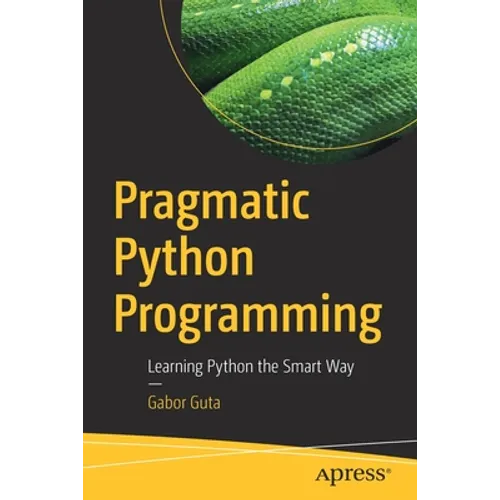
Product Description
by Gabor Guta (Author)
Explore the world of programming languages through Python and learn the building blocks of writing programs. This book covers Python 3.10, explaining it through six key concepts. Each chapter contains a real-world example with practical advice and a section on advanced concepts.
You'll start by reviewing the concept of expressions and functions, which are two of the core building blocks of programming languages. You'll then move on to object-oriented concepts to help gain a practical understanding of Python, along with a chapter on control flow constructs. The book also takes a close look at sequences, explaining constructs and additional types, and wraps up with a chapter on modules, focusing on how to use and create packages.
Whether you're new to programming or already an experienced developer, upon finishing this book, you will have a solid understanding of Python's state-of-the-art development features.
What You Will Learn
- Study the six main concepts of the programming languages
- Learn how to use programming language constructs through examples
- Review the core Python language notations and concepts.
- Start using Python as a working language
Software developers wanting to gain professional core Python knowledge quickly, and non-developers wanting to gain an understanding of programming concepts.
Back Jacket
Explore the world of programming languages through Python and learn the building blocks of writing programs. This book covers Python 3.10, explaining it through six key concepts. Each chapter contains a real-world example with practical advice and a section on advanced concepts.
You'll start by reviewing the concept of expressions and functions, which are two of the core building blocks of programming languages. You'll then move on to object-oriented concepts to help gain a practical understanding of Python, along with a chapter on control flow constructs. The book also takes a close look at sequences, explaining constructs and additional types, and wraps up with a chapter on modules, focusing on how to use and create packages.
Whether you're new to programming or already an experienced developer, upon finishing this book, you will have a solid understandYou will:
- Study the six main concepts of the programming languages
- Learn how to use programming language constructs through examples
- Review the core Python language notations and concepts.
- Start using Python as a working language
Author Biography
Gabor Guta has studied and researched at Research Institute for Symbolic Computation, Johannes Kepler University, Linz to gain an understanding of the formal meaning of programming languages. He worked on complex technology transfer and cheminformatics projects where both strong theoretical background and practical software development skills were crucial. Currently, he is developing distributed software for bioinformatics and system biology projects. Beside his software development work, he has been continuously training people both in academic and industrial settings. He has been actively teaching Python since 2017.