


Product Description
by R. R. Asaadi (Author)
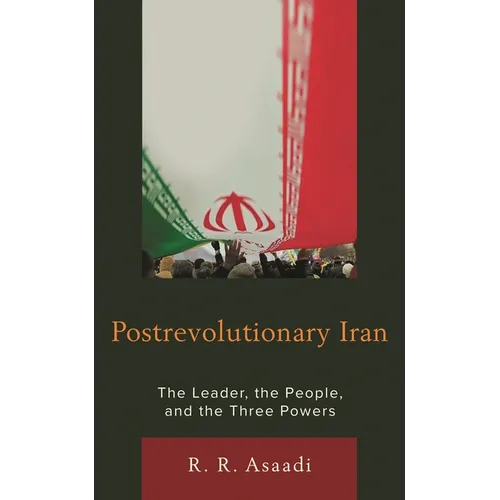
How is Iran governed? Is the state accountable to its society? How have Iran's political institutions evolved since the 1979 revolution? In short, Postrevolutionary Iran: the Leader, the People, and the Three Powers argues that the answers to these critical questions are neither as certain nor as fixed as much of the existing literature on this topic would lead one to believe. Part 1 of the book (chapters 1-3) analyzes what Iran's Constitution refers to as "the Three Powers" the executive, legislative, and judicial branches of government along with the unique mediating institutions of the Guardian and Expediency Councils. In each chapter, the author describes the unique structure and function of the governing institution as outlined in Iran's Constitution, then explains how the institution has evolved in practice over time. Several trends emerge from this analysis, including, among others, the growing influence of the military in politics, the expanding power of the Guardian Council at the expense of the parliament, and the widening asymmetry of executive power favoring the supreme leader at the expense of the president. In Part 2 of the book (chapters 4-6), the analytical focus shifts from Iran's formal political institutions to consider instead the relationship between state and society more broadly, with chapters on Iran's military and economic structure, social movements, and public attitudes and the media. Finally, in the concluding chapter, the author offers a comprehensive view of what this analysis of Iran's political institutions in theory and practice reveals about both the resilience of Iran's political system and its capacity for meaningful change.
Author Biography
R.R. Asaadi is instructor in the College of Urban and Public Affairs at Portland State University in Portland, Oregon.