


Product Description
by Ruthellen Josselson (Author)
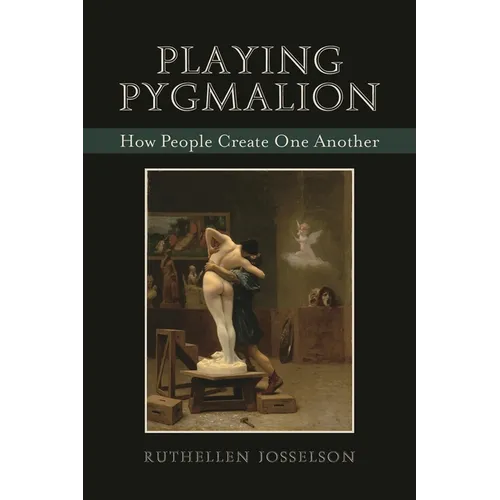
Like Pygmalion with his Galatea, we create the characters of people in our lives. Although others appear to us to be who they just "are", there are complicated psychological processes, outside of our awareness, that lead us to experience people in ways that we ourselves construct.
Psychoanalytic theory offers a wealth of understanding of how people unconsciously create what they both need and dread. But these processes are not well understood by most therapists. Too often, therapists join their patients in overlooking their own role in creating the relationships in their lives, such that it seems that patients were simply unfortunate to "have" an un-giving mother or to "find" an unloving spouse. Because processes of creation in relationship are largely unconscious, they are much harder to see. As a result, most theorists of relationships acknowledge that they exist, but offer little language or explication for how they unfold or manifest themselves. Playing Pygmalion is an effort to trace in psychological terms the subtle interplay by which people create the other.
This book adapts the psychoanalytic concepts of transitional object usage and projective identification to show their importance and applicability beyond the therapeutic situation to the understanding of people's relational lives. Using examples from literature, film and clinical work to illustrate the theory, the book goes on to consider in depth the relationship narratives of four pairs of ordinary people to demonstrate how people unconsciously "create" one another.
The stories demonstrate that the "other" is always more than one conceives him or her to be. Readers inevitably rethink some of their important relationships in terms of how they are creating people or being created by them. This may lead them to take in other aspects of the person, to see how they are looking very selectively at a human being who exists beyond their relationship. These stories also provide cautionary tales to therapists who begin to believe in the simpl
Author Biography
Ruthellen Josselson, Ph.D. is professor of psychology at The Fielding Graduate University and was formerly professor at The Hebrew University of Jerusalem as well as at Harvard University. Recipient of the Henry A. Murray Award from the American Psychological Association and a Fulbright Fellowship, she is also a practicing psychotherapist. Her research interests focus on the use of narrative to understand people's life histories and she has authored several books on relationships and on women's identity. She has also co-edited the series The Narrative Study of Lives.