


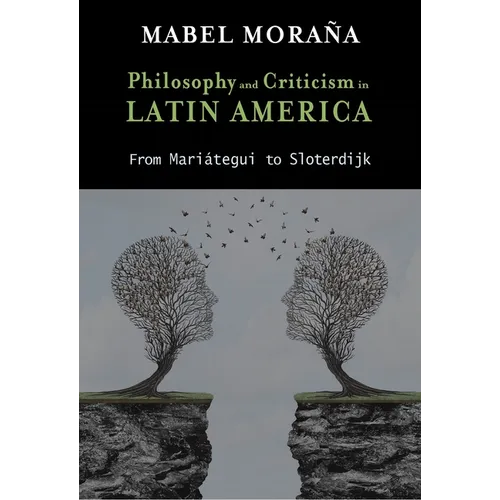
Product Description
by Mabel Moraña (Author)
This book is in the Cambria Latin American Literatures and Cultures Series headed by Rom n de la Campa, the Edwin B. and Lenore R. Williams Professor of Romance Languages at the University of Pennsylvania.
The objective of this book is not to recognize once again the sources of pre-Hispanic Amerindian or Afro-Hispanic thought in different regions and historical moments--a task that other critics have already accomplished admirably. Nor does this book attempt to return to the debates around the existence of a properly Latin American philosophy--a question that has also been thoroughly addressed. Rather, this book offers timely contributions to the process of conceptualizing a Latin American specificity and its forms of integration in larger contexts, both on the level of thought and the level of political and social praxis. To produce a critical reading of philosophy while also developing a philosophy of criticism is essential in cultures that continue to struggle for the decolonization of both thought and life.
The first part of the book, "Biopower, Coloniality, and Emancipation in Latin America," examines authors and addressses questions from Latin American contexts in dialogue with some of the greatest thinkers of the twentieth century. These texts analyze the contributions of these authors to debates on such topics as the problems of colonialism and coloniality, the critique of modernity, and violence. Discussions of these issues give rise to other questions linked to the notions of freedom, social change, post/trans/modernity, biopolitics, and other topics that are particularly relevant for interpreting the processes of national formation and modernization and for understanding the developments that have taken place in the decades following the end of the Cold War.
The second part of the book, titled "Critico-Philosophical Re-Readings and Debates," brings together texts that cover the work of philosophers whose ideas have strong links to Latin American thought. Benjamin, Foucault, and Bourdieu are all quite different thinkers, but they have in common the objective of deconstructing the discourse of power from different angles, providing forms of social consciousness that are in dialogue with Latin American critical and emancipatory projects on multiple levels. In addition to the above-mentioned philosophical directions, Peter Sloterdijk's undeniably polemical thought opens up a new path for the critique of humanism. These approaches are studied in the present book in texts that constitute moments of critical reflection which, while recognizing these authors' contributions to the development of critico-philosophical thought in peripheral areas, analyze aspects of their thought that can be interrogated and even challenged from a Latin American perspective. In this sense, this book suggests that, from the vantage point of Latin American cultural and political history, European philosophy, in spite of its claims of universality, clearly lacks satisfactory approaches to issues related to post/neo/colonial realities.
With its interdisciplinary focus, this book will be an important resource for scholars and students in Latin American studies, comparative literature, world literature, and philosophy.



