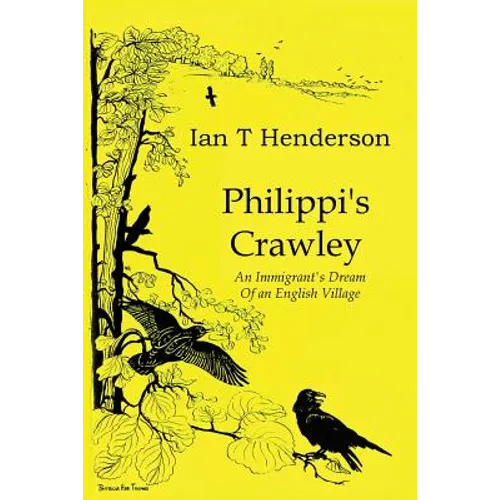
Product Description
by Ian Henderson (Author), Sedley Proctor (Editor), Tony Henderson (Foreword by)
"Philippi's Crawley (from C M Printing Services, 20a Jewry Street, Winchester, 1) by I T Henderson is a history of that village - four and a half miles from Winchester - largely in relation to Otto Ernst Philippi, the man who, by 1900, had built the Glasgow firm of J & P Coats (now Coats Patons) into Britain's largest industrial concern. In that year he announced his retirement, bought Crawley Court, a Victorian building which, like the rest of the village, had become almost derelict, and announced his intention to settle there. His fellow directors held his business ability in such respect that they persuaded him to continue to control the company - even from Crawley. He consented to do so: but would go to Glasgow only for the monthly board meetings; and, since he would not have a telephone in the house, he managed the firm by letter and telegram. Indeed, his directions were so constant that one boy had to be employed full time at the village Post Office to maintain the two-way flow. He also found time to reshape Crawley. Born in Prussia, he was a stern, if basically benevolent, despot. He set out to buy most of the houses and cottages in the village, hoping, and often stipulating, that the occupiers who sold to him would continue to live in them for the rest of their lives. So he succeeded in turning the formerly dilapidated into a 'model village' - though one which was described as 'the appearance of a model village almost devoid of a single striking corner or nook, which is neat and seems clean, but none of it is the object of an artist's pilgrimage.' After his death in 1917 his son vested a restricted covenant in the estate s that subsequent residents in the village were able to resist commercial 'development' until, in 1970, the Independent Broadcasting Authority bought the manor, demolished it, built a modern office block on the site and moved into what they described as 'the Queen of Hampshire Villages'. John Arlott, writer, broadcaster and voice of English cricket, writing in Hampshire, The County Magazine, September 1977, Vol.17, No. 11