


Product Description
by Kenneth J. Berry (Author), Kenneth L. Kvamme (Author), Janis E. Johnston (Author)
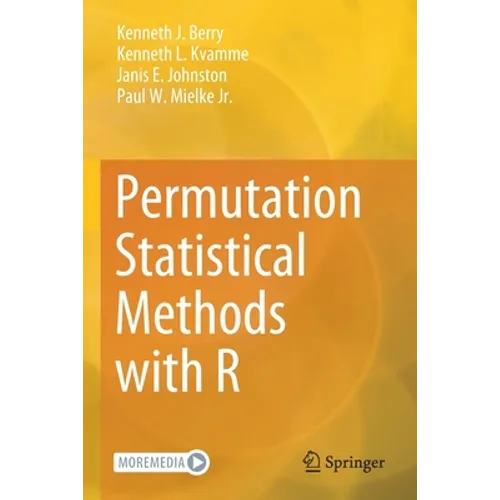
This book takes a unique approach to explaining permutation statistics by integrating permutation statistical methods with a wide range of classical statistical methods and associated R programs. It opens by comparing and contrasting two models of statistical inference: the classical population model espoused by J. Neyman and E.S. Pearson and the permutation model first introduced by R.A. Fisher and E.J.G. Pitman. Numerous comparisons of permutation and classical statistical methods are presented, supplemented with a variety of R scripts for ease of computation. The text follows the general outline of an introductory textbook in statistics with chapters on central tendency and variability, one-sample tests, two-sample tests, matched-pairs tests, completely-randomized analysis of variance, randomized-blocks analysis of variance, simple linear regression and correlation, and the analysis of goodness of fit and contingency.
Unlike classical statistical methods, permutation statistical methods do not rely on theoretical distributions, avoid the usual assumptions of normality and homogeneity, depend only on the observed data, and do not require random sampling. The methods are relatively new in that it took modern computing power to make them available to those working in mainstream research.Designed for an audience with a limited statistical background, the book can easily serve as a textbook for undergraduate or graduate courses in statistics, psychology, economics, political science or biology. No statistical training beyond a first course in statistics is required, but some knowledge of, or some interest in, the R programming language is assumed.
Back Jacket
This book takes a unique approach to explaining permutation statistics by integrating permutation statistical methods with a wide range of classical statistical methods and associated R programs. It opens by comparing and contrasting two models of statistical inference: the classical population model espoused by J. Neyman and E.S. Pearson and the permutation model first introduced by R.A. Fisher and E.J.G. Pitman. Numerous comparisons of permutation and classical statistical methods are presented, supplemented with a variety of R scripts for ease of computation. The text follows the general outline of an introductory textbook in statistics with chapters on central tendency and variability, one-sample tests, two-sample tests, matched-pairs tests, completely-randomized analysis of variance, randomized-blocks analysis of variance, simple linear regression and correlation, and the analysis of goodness of fit and contingency.
Unlike classical statistical methods, permutation statistical methods do not rely on theoretical distributions, avoid the usual assumptions of normality and homogeneity, depend only on the observed data, and do not require random sampling. The methods are relatively new in that it took modern computing power to make them available to those working in mainstream research.Designed for an audience with a limited statistical background, the book can easily serve as a textbook for undergraduate or graduate courses in statistics, psychology, economics, political science or biology. No statistical training beyond a first course in statistics is required, but some knowledge of, or some interest in, the R programming language is assumed.
Author Biography
Kenneth J. Berry earned his Ph.D. in Sociology at the University of Oregon and is Professor in the Department of Sociology at Colorado State University, Fort Collins, Colorado, USA. His research interests are in non-parametric and distribution-free statistical methods.
Kenneth L. Kvamme earned his Ph.D. in Anthropology at the University of California, Santa Barbara and is Professor in the Department of Anthropology and Director of the Archeo-Imagining Laboratory at the University of Arkansas, Fayetteville, Arkansas, USA. His research interests include archeological computer applications, GIS, lithic technology, remote sensing, geophysical prospecting, and spatial analysis methods.
Janis E. Johnston earned her Ph.D. in Sociology at Colorado State University and is a Senior Technical Advisor for the U.S. Government in Alexandria, Virginia, USA and a Faculty Affiliate in the Department of Sociology at Colorado State University, Fort Collins, Colorado, USA.
Paul W. Mielke, Jr. earned his Ph.D. in Biostatistics at the University of Minnesota and was Emeritus Professor of Statistics at Colorado State University, Fort Collins, Colorado, USA, and Fellow of the American Statistical Association. His research interests were in multivariate statistics and permutation statistical methods. Paul Mielke passed away on 20 April 2019.



