Skip to content
Save 5% on your next order with code PREMIUM5!
100,000+ Products for Home, Medical, Office & Classroom Needs
Search
Skip to product information
1 of 1

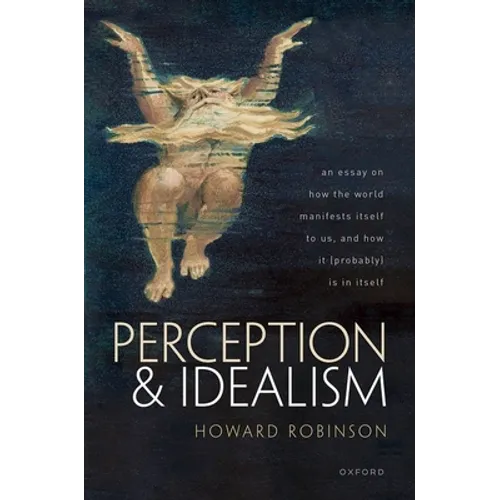
Perception and Idealism: An Essay on How the World Manifests Itself to Us, and How It (Probably) Is in Itself - Hardcover

$188.10 USD
$188.10 USD
Sale Sold out
Shipping calculated at checkout.
In stock (22 units), ready to be shipped

Available Offers

Fast delivery available on most orders

Multiple secure payment options accepted

Secure checkout with
  • American Express
  • Apple Pay
  • Diners Club
  • Discover
  • Google Pay
  • Mastercard
  • PayPal
  • Shop Pay
  • Visa

Flight Range: Up to 1,000 meters (3,280 feet)

Maximum Speed: 45 kilometers per hour (28 miles per hour)

For all orders exceeding a value of 100USD shipping is offered for free.

Returns will be accepted for up to 10 days of Customer’s receipt or tracking number on unworn items. You, as a Customer, are obliged to inform us via email before you return the item.

Otherwise, standard shipping charges apply. Check out our delivery Terms & Conditions for more details.

View Product Details
Shopping cart
Product Product subtotal Quantity Price Product subtotal
Perception and Idealism: An Essay on How the World Manifests Itself to Us, and How It (Probably) Is in Itself - Hardcover
$188.10/ea
$0.00
$188.10/ea $0.00

Product Description

by Howard Robinson (Author)

Perception and Idealism takes up two long-standing philosophical problems: how perception makes objects manifest to us, and what the world must be like for objects to be manifest in that way. Part I addresses the nature of perception. A detailed discussion of contemporary versions of naïve realist and of intentionalist theories is provided, and refutations offered of both. Robinson argues that sense-datum theory is not subject to any of the vices normally attributed to it, but in fact allows one to say that we directly perceive objects as being the way that they naturally manifest themselves to creatures like us. The sense-datum theory can be reconciled with a form of direct realism, once one understands properly the cognitive and the phenomenal components in perception, a relationship which intentionalist theories confuse. As perception makes us aware of objects as they manifest themselves to us, this leaves open the question of what they are like in themselves. This is the
topic of Part II. A variety of realist conceptions of the material world are considered and found to be either empty or less plausible than idealism: the 'powers' conception of matter, Lewis's quiddities, Esfeld's 'matter points', and quantum theory. The problem of giving a realist account of space is also developed. Turning to mentalist options, simple phenomenalism and panpsychism are discussed and rejected. Robinson concludes that Berkeley's theistic phenomenalism, or idealism, is the most plausible account.

Author Biography


Howard Robinson, Professor Emeritus in Philosophy, Central European University, Vienna

Howard Robinson is Professor Emeritus in Philosophy at Central European University, Vienna. He is also Research Fellow at Blackfriars Hall, Oxford, and Senior Fellow, Rutgers Center for Philosophy of Religion. He was educated at Manchester Grammar School and Corpus Christi College, Oxford. He previously held positions at the University of Nottingham, Oriel College, Oxford, University of Liverpool, and Eötvös Loránd University, Budapest.
Number of Pages: 256
Dimensions: 0.82 x 9.47 x 6.41 IN
Publication Date: February 17, 2023
you might like