


Product Description
by James R. Harrison (Author)
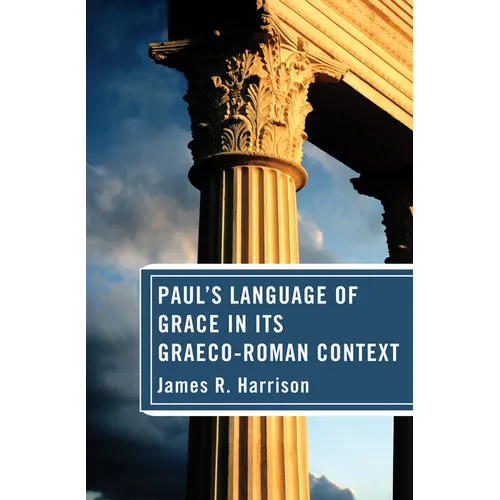
Paul's Language of Grace in Its Graeco-Roman Context was originally published by Mohr Siebeck in 2003 and is now reprinted by Wipf and Stock with a new introduction by its author, James R. Harrison. The book was the first major investigation of charis ('grace', 'favor') in its social, political, and religious context since G. P. Wetter's pioneering 1913 monograph on the topic. Focusing on the evidence of the inscriptions, papyri, philosophers, and Greek Jewish literature, Harrison examined the operations of the eastern Mediterranean benefaction system, probing the dynamic of reciprocity between the beneficiary and benefactor, whether human or divine. Before Paul's converts were first exposed to the gospel, they would have held a variety of beliefs regarding the beneficence of the gods. The apostle, therefore, needed to tailor his language of grace as much to the theological and social concerns of the Mediterranean city-states in his missionary outreach as to the variegated traditions of first-century Judaism. In terms of human grace, although Paul endorses the reciprocity system, he redefines its rationale in light of the gospel of grace and transforms its social expression in his house churches. The explosion of 'grace' language that occurs in 2 Corinthians 8-9 regarding the Jerusalem collection is unusual in its frequency in comparison to the honorific inscriptions, underscoring the apostle's distinctive approach to giving. Regarding divine beneficence, Paul accommodates his gospel to contemporary benefaction idiom. But he retains a distinctiveness of viewpoint regarding divine charis: it is non-cultic; it is mediated through a dishonored and impoverished Benefactor; it overturns the do ut des expectation ('I give so that you may give') regarding divine blessing in antiquity. Harrison's book still remains the authoritative coverage of the Graeco-Roman context of charis. James R. Harrison is Professor and Director of Research at Sydney College of Divinity, Australia, and Honorary Associate of Macquarie University Ancient History Department. He is author of Paul and the Imperial Authorities at Thessalonica and Rome (Mohr Siebeck, 2011), and co-editor of volume 10 of New Documents Illustrating Early Christianity (Eerdmans, 2012). His new book, Paul and the Ancient Celebrity Circuit: The Cross and Character Formation, is another Mohr Siebeck publication forthcoming. Along with Larry Welborn, he is also co-editor of the SBL series on urban Christianity, The First Urban Churches, with volumes published on the methodology of studying ancient cities (2015), Roman Corinth (2016), and Ephesus (2017). Harrison also edits the renamed pentad, New Documents Illustrating the History of Early Christianity Vols 11-15, investigating the inscriptions of the major New Testament cities.
Author Biography
James R. Harrison is Professor and Director of Research at Sydney College of Divinity, Australia, and Honorary Associate of Macquarie University Ancient History Department. He is author of Paul and the Imperial Authorities at Thessalonica and Rome (Mohr Siebeck, 2011), and co-editor of volume 10 of New Documents Illustrating Early Christianity (Eerdmans, 2012). His new book, Paul and the Ancient Celebrity Circuit: The Cross and Character Formation, is another Mohr Siebeck publication forthcoming. Along with Larry Welborn, he is also co-editor of the SBL series on urban Christianity, The First Urban Churches, with volumes published on the methodology of studying ancient cities (2015), Roman Corinth (2016), and Ephesus (2017). Harrison also edits the renamed pentad, New Documents Illustrating the History of Early Christianity Vols 11-15, investigating the inscriptions of the major New Testament cities.