


Product Description
by John Hait (Author)
Still the World's Most Advanced Text on Earth Sheltering and Passive Solar Design
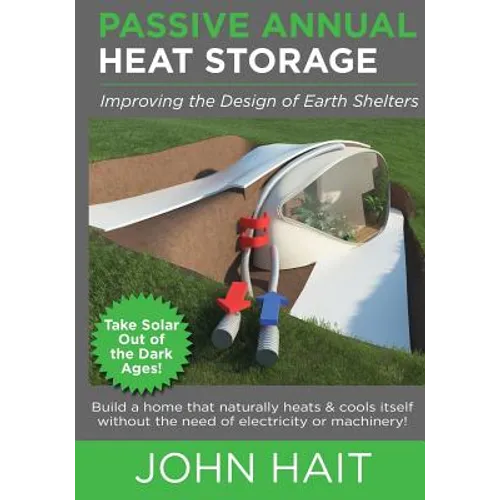
Passive Annual Heat Storage (PAHS) is a method of collecting heat in the summertime, by cooling the home naturally, storing it in the earth naturally, then returning the heat to the home in the winter. It includes extensive use of natural heat flow methods and the arrangement of building materials to direct heat from wherever you get it to wherever you want it, all without using machinery to make it work. With the rising cost of energy, all home builders should become familiar with basic PAHS principles.
The goal of Passive Annual Heat Storage is to provide a method of placing building materials and organizing construction so the comfortable environments produced are continuously pleasant. The resulting subterranean home interiors are balanced with the natural environment and are able to extract all of their energy needs from their surroundings without using any commercial energy sources. Thus, there is no longer any need for using mechanical devices or causing any disruption in global ecosystems.
Build a home that naturally stays warm in the winter and cool in the summer
Author Biography
John Hait began inventing at the age of ten, when he obtained his first Amateur Radio License. Following four years of electronics training in the U.S. Air Force, he returned to the University of Montana and the Missoula Technical Center. In 1981, he founded the Rocky Mountain Research Center as a nonprofit scientific research and educational corporation in Montana, its purpose being to advance these exciting new sciences, and teach others about them.
He has over 48 U.S. patents and patents pending covering nearly the entire foundation of photonic computing and fully photonic telecommunications. This work led him to discover the pseudorandomness of nature and from that, the fundamental mechanism of physics, Resonant Fields.
A prolific commercial inventor, his work spans a wide range of physics including secure electronics, high-speed 2048 bit encryption, HDTV, high-bandwidth radio and other photonic transmission systems, alternative energy production, water and gasohol distillation, wave, wind and water power... along with solar power that doesn't run down at sundown!
In 1979 he invented Passive Annual Heat Storage, a natural method of collecting heat in the summertime and storing it until winter.
An accomplished writer and public speaker, he completed his first book in 1983, "Passive Annual Heat Storage," which has sold world-wide. Then he wrote the book, "How to Recycle Scrap Metal into Electricity", all about Rust Power! Plus he wrote for numerous magazines including cover stories for Popular Science, Mother Earth News and the Computer Applications Journal.



