Product Description
by Richard Abel (Author)
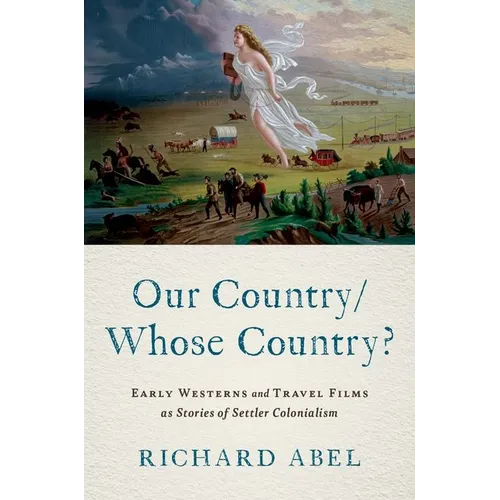
The concept of settler colonialism offers an invaluable lens to reframe early westerns and travel pictures as re-enactments of the United States' repressed past. Westerns in particular propose a remarkable vision of white settlers' westward expansion that reveals a transformation in what "American Progress" came to mean.
Initially, these films tracked settlers moving westward across the Appalachians, Great Plains, and Rockies. Their seizure of "empty land" provoked continual resistance from Indigenous peoples and Mexicans; "pioneers" suffered extreme hardships, but heroic male figures usually scattered or wiped out those "aliens." Some films indulged in nostalgic empathy for the Indian as a "Vanishing American." In the early 1910s, westerns became increasingly popular. In Indian pictures, Native Americans ranged from devious savages, victims of white violence, and "Noble Savages" to "in-between" figures caught between cultures and "mixed-descent peoples" partnered for security or advantage. Mexicans took positions across a similar spectrum. In cowboy and cowgirl films, "ordinary" whites became heroes and heroines fighting outlaws; and bandits like Broncho Billy underwent transformation into "good badmen." The mid to late 1910s saw a shift, as Indian pictures and cowgirl films faded and male figures, embodied by movie stars, dominated popular series. In different ways, William S. Hart and Harry Carey reinvented the "good badman" as a stoic, if troubled, figure of white masculinity. In cowboy films of comic romance, Tom Mix engaged in dangerous stunts and donned costumes that made him a fashionable icon. In parodies, Douglas Fairbanks subverted the myth of "American Progress," sporting a nonchalant grin of effortless self-confidence. Nearly all of their films assumed firmly settled white communities, rarely threatened by Indians or Mexicans. Masked as "Manifest Destiny," the expropriation of the West seemed settled once and for all. Our Country/Whose Country? offers a rich and expansive examination of the significance of early westerns and travel pictures in the ideological foundations of "our country."Author Biography
Richard Abel is Emeritus Professor of International Cinema and Media at the University of Michigan. The most recent of his dozen books is Movie Mavens: US Newspaper Women Take on the Movies, 1914-1923 (2021). His essays have appeared in scores of journals and been translated into five languages. He received the 2014 SCMS Distinguished Career Achievement Award and the 2017 Jean Mitry Award.
Number of Pages: 256
Dimensions: 0.37 x 9.28 x 6.3 IN
Publication Date: November 14, 2023