


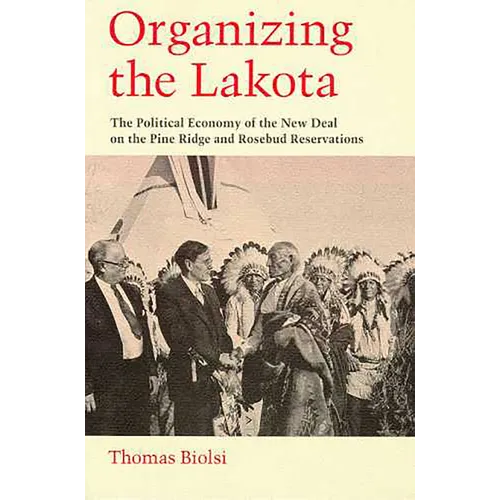
Product Description
by Thomas Biolsi (Author)
In 1933 the United States Office of Indian Affairs began a major reform of Indian policy, organizing tribal governments under the provisions of the Indian Reorganization Act and turning over the administration of reservations to these new bodies. Organizing the Lakota considers the implementation of this act among the Lakota (Western Sioux or Teton Dakota) from 1933 through 1945.
Biolsi pays particular attention to the administrative means by which the OIA retained the power to design and implement tribal "self-government" as well as the power to control the flow of critical resources--rations, relief employment, credit--to the reservations. He also shows how this imbalance of power between the tribes and the federal bureaucracy influenced politics on the reservations, and argues that the crisis of authority faced by the Lakota tribal governments among their own would-be constituents--most dramatically demonstrated by the 1973 Wounded Knee occupation--is a direct result of their disempowerment by the United States.Front Jacket
In 1933 the United States Office of Indian Affairs began a major reform of Indian policy, organizing tribal governments under the provisions of the Indian Reorganization Act and turning over the administration of reservations to these new bodies. "Organizing the Lakota" considers the implementation of this act among the Lakota (Western Sioux or Teton Dakota) from 1933 through 1945. Biolsi pays particular attention to the administrative means by which the OIA retained the power to design and implement tribal "self-government" as well as the power to control the flow of critical resources--rations, relief employment, credit--to the reservations. He also shows how this imbalance of power between the tribes and the federal bureaucracy influenced politics on the reservations, and argues that the crisis of authority faced by the Lakota tribal governments among their own would-be constituents--most dramatically demonstrated by the 1973 Wounded Knee occupation--is a direct result of their disempowerment by the United States.
Back Jacket
In 1933 the United States Office of Indian Affairs, under the commissionership of John Collier, began a major reform of Indian policy. Known as the Indian New Deal, the official reform agenda included organizing tribal governments under the provisions of the Indian Reorganization Act and turning over the administration of reservations to these new bodies. Organizing the Lakota considers the implementation of this act among the Lakota (Western Sioux or Teton Dakota) of the Pine Ridge and Rosebud reservations in South Dakota from 1933 through 1945. Based primarily upon Office of Indian Affairs records and fieldwork on the reservations, it focuses on the ways in which tribal organization, which was officially intended to empower the tribes, ultimately failed to transfer power from the OIA to the tribal governments. Biolsi pays particular attention to the administrative means by which the OIA retained the power to design and implement tribal "self-government", as well as the power to control the flow of critical resources - rations, relief employment, credit - to the reservations. He also shows how this imbalance of power between the tribes and the federal bureaucracy influenced politics on the reservations, and he argues that the crisis of authority faced by the Lakota tribal governments among their own would-be constituents - most dramatically demonstrated by the 1973 Wounded Knee occupation - is a direct result of their disempowerment by the United States.
Author Biography
Thomas Biolsi is an associate professor in the Anthropology Department at Portland State University.



