


Product Description
by Chad Wellmon (Author)
The Enlightenment-era concerns that gave rise to the modern research university can illuminate contemporary debates about knowledge in the digital age.
Since its inception, the research university has been the central institution of knowledge in the West. Today its intellectual authority is being challenged on many fronts, above all by radical technological change. Organizing Enlightenment tells the story of how the university emerged in the early nineteenth century at a similarly fraught moment of cultural anxiety about revolutionary technologies and their disruptive effects on established institutions of knowledge.
Drawing on the histories of science, the university, and print, as well as media theory and philosophy, Chad Wellmon explains how the research university and the ethic of disciplinarity it created emerged as the final and most lasting technology of the Enlightenment. Organizing Enlightenment reveals higher education's story as one not only of the production of knowledge but also of the formation of a particular type of person: the disciplinary self. In order to survive, the university would have to institutionalize a new order of knowledge, one that was self-organizing, internally coherent, and embodied in the very character of the modern, critical scholar.
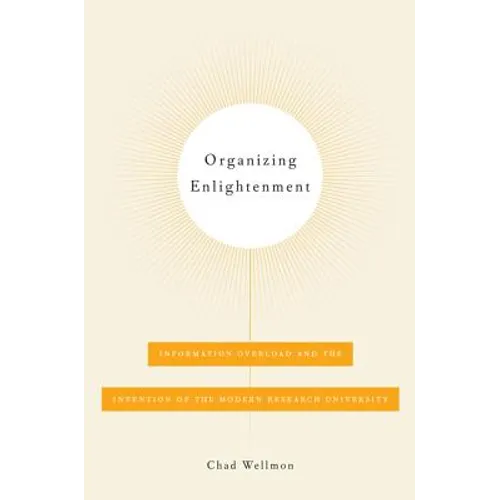
Front Jacket
Since its inception, the research university has been the central institution of knowledge in the West. Today its intellectual authority is being challenged on many fronts, above all by radical technological change. Organizing Enlightenment tells the story of how the university emerged in the early nineteenth century at a similarly fraught moment of cultural anxiety about revolutionary technologies and their disruptive effects on established institutions of knowledge.
Drawing on the histories of science, the university, and print, as well as media theory and philosophy, Chad Wellmon explains how the research university and the ethic of disciplinarity it created emerged as the final and most lasting technology of the Enlightenment. Organizing Enlightenment reveals higher education's story as one not only of the production of knowledge but also of the formation of a particular type of person: the disciplinary self. In order to survive, the university would have to institutionalize a new order of knowledge, one that was self-organizing, internally coherent, and embodied in the very character of the modern, critical scholar.
Organizing Enlightenment helps us understand how specialization is not a new problem to be solved but the answer to an older problem of media surplus which we still inhabit. The more we hear calls for the reform of research universities today, the more we will need such insightful and clearly written histories as this one.--Andrew Piper, McGill University
The crisis of the university in the age of MOOCs and the new media? As Chad Wellmon shows in this learned and lucid study, we've been there before, several times.--Lorraine Daston, Max Planck Institute for the History of Science, Berlin
Organizing Enlightenment shows just how much our own technologies and freedoms grew directly from German university traditions. It is eye-opening history and necessary reading for anyone who thinks the humanities play a secondary role to technology.--Jacob Soll, University of Southern California
Chad Wellmon is an associate professor of German studies at the University of Virginia and a faculty fellow at the Institute for Advanced Studies in Culture. He is the author of Becoming Human: Romantic Anthropology and the Embodiment of Freedom.
--Jacob Soll, author of The Information Master: Jean-Baptiste Colbert's Secret State Intelligence System "Choice"Back Jacket
Since its inception, the research university has been the central institution of knowledge in the West. Today its intellectual authority is being challenged on many fronts, above all by radical technological change. Organizing Enlightenment tells the story of how the university emerged in the early nineteenth century at a similarly fraught moment of cultural anxiety about revolutionary technologies and their disruptive effects on established institutions of knowledge.
Drawing on the histories of science, the university, and print, as well as media theory and philosophy, Chad Wellmon explains how the research university and the ethic of disciplinarity it created emerged as the final and most lasting technology of the Enlightenment. Organizing Enlightenment reveals higher education's story as one not only of the production of knowledge but also of the formation of a particular type of person: the disciplinary self. In order to survive, the university would have to institutionalize a new order of knowledge, one that was self-organizing, internally coherent, and embodied in the very character of the modern, critical scholar.
"Organizing Enlightenment helps us understand how specialization is not a new problem to be solved but the answer to an older problem of media surplus which we still inhabit. The more we hear calls for the reform of research universities today, the more we will need such insightful and clearly written histories as this one."--Andrew Piper, McGill University
"The crisis of the university in the age of MOOCs and the new media? As Chad Wellmon shows in this learned and lucid study, we've been there before, several times."--Lorraine Daston, Max Planck Institute for the History of Science, Berlin
"Organizing Enlightenment shows just how much our own technologies and freedoms grew directly from German university traditions. It is eye-opening history and necessary reading for anyone who thinks the humanities play a secondary role to technology."--Jacob Soll, University of Southern California
Chad Wellmon is an associate professor of German studies at the University of Virginia and a faculty fellow at the Institute for Advanced Studies in Culture. He is the author of Becoming Human: Romantic Anthropology and the Embodiment of Freedom.
Author Biography
Chad Wellmon is an associate professor of German studies at the University of Virginia and a faculty fellow at the Institute for Advanced Studies in Culture. He is the author of Becoming Human: Romantic Anthropology and the Embodiment of Freedom.



