


Product Description
by James A. Oliveri Jr. (Author)
Merriam Press World War 2 History Series
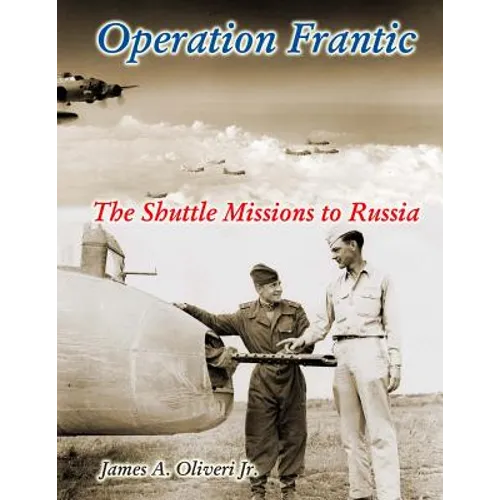
Operation Frantic was a series of seven shuttle bombing operations during World War II conducted by American aircraft based in Great Britain (Eighth Air Force) and Southern Italy (Fifteenth Air Force) which then landed at three Soviet airfields in Ukraine. The operation began in June, 1944 and ended in September.During the four months of major operations, 24 targets in German-held territory, some never before within effective range of the American strategic bomber forces, were attacked.
While the shuttle bombing technique complicated German air defenses, in practice most targets were already coming in reach of U.S. bomber streams from Italy and England. Soviet vetoing of some targets prevented more effective use of the bases.
The operations were reduced and finally discontinued due to 1) a catastrophic German air attack on the bases in June, 2) Soviet hostility and non-cooperation that began in August, and 3) the inability of the Americans to receive permission to use the bases for support of the Warsaw Uprising, which soured relations between the two countries.
The main operational difficulty encountered by the U.S. forces was inadequate force protection by the Soviets. The Soviets refused US requests to introduce adequate radar-guided artillery and night fighter support, and U.S. aircraft were frequently fired upon by Soviet forces.
The three bases reached their peak in July and August 1944, with a firmly limited complement of 1300 U.S. officers and men. By October, operations were put on a "skeleton crew" basis, with a winter contingent at Poltava only of about 300. Americans remained there until evacuation after VE-day.
Operation Frantic has greater historical importance for the development of Soviet-American relations than for its effect on Germany's war effort. Starting out with high hopes, it eventually set a discordant note that foreshadowed the Cold War.
Author Oliveri has provided a history from the viewpoint of the men who flew and supported the operation. The author's grandfather, Thomas Ford, participated in the first three missions of the operation.
Features 133 photos, some of which are from Ford's collection, and one map.



