


Product Description
by Newton C. a. Da Costa (Author), Francisco Antonio Doria (Author)
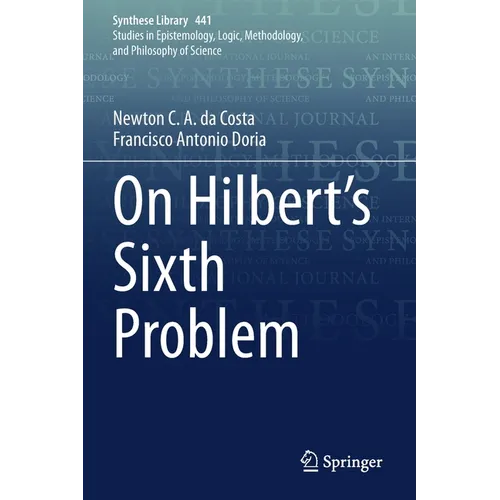
This book explores the premise that a physical theory is an interpretation of the analytico-canonical formalism. Throughout the text, the investigation stresses that classical mechanics in its Lagrangian formulation is the formal backbone of theoretical physics. The authors start from a presentation of the analytico-canonical formalism for classical mechanics, and its applications in electromagnetism, Schrödinger's quantum mechanics, and field theories such as general relativity and gauge field theories, up to the Higgs mechanism.
The analysis uses the main criterion used by physicists for a theory: to formulate a physical theory we write down a Lagrangian for it. A physical theory is a particular instance of the Lagrangian functional. So, there is already an unified physical theory. One only has to specify the corresponding Lagrangian (or Lagrangian density); the dynamical equations are the associated Euler-Lagrange equations. The theory of Suppes predicates as the main tool inthe axiomatization and examples from the usual theories in physics. For applications, a whole plethora of results from logic that lead to interesting, and sometimes unexpected, consequences.This volume looks at where our physics happen and which mathematical universe we require for the description of our concrete physical events. It also explores if we use the constructive universe or if we need set-theoretically generic spacetimes.Back Jacket
This book explores the premise that a physical theory is an interpretation of the analytico-canonical formalism. Throughout the text, the investigation stresses that classical mechanics in its Lagrangian formulation is the formal backbone of theoretical physics. The authors start from a presentation of the analytico-canonical formalism for classical mechanics, and its applications in electromagnetism, Schrödinger's quantum mechanics, and field theories such as general relativity and gauge field theories, up to the Higgs mechanism.
The analysis uses the main criterion used by physicists for a theory: to formulate a physical theory we write down a Lagrangian for it. A physical theory is a particular instance of the Lagrangian functional. So, there is already an unified physical theory. One only has to specify the corresponding Lagrangian (or Lagrangian density); the dynamical equations are the associated Euler-Lagrange equations. The theory of Suppes predicates as the main tool in the axiomatization and examples from the usual theories in physics. For applications, a whole plethora of results from logic that lead to interesting, and sometimes unexpected, consequences. This volume looks at where our physics happen and which mathematical universe we require for the description of our concrete physical events. It also explores if we use the constructive universe or if we need set-theoretically generic spacetimes.Author Biography
Francisco Antonio Doria is Professor Emeritus, UFRJ. PhD (mathematical physics, advisor Leopoldo Nachbin, 1977, CBPF, Rio Brazil). With Newton da Costa settled the 1976 Arnol'd Hilbert Symposium Problems; proved that chaos in dynamical systems theory is undecidable.
Newton C. A. da Costa is a well-known expert in the field of nonclassical logics, developed the theory of paraconsistent logics.