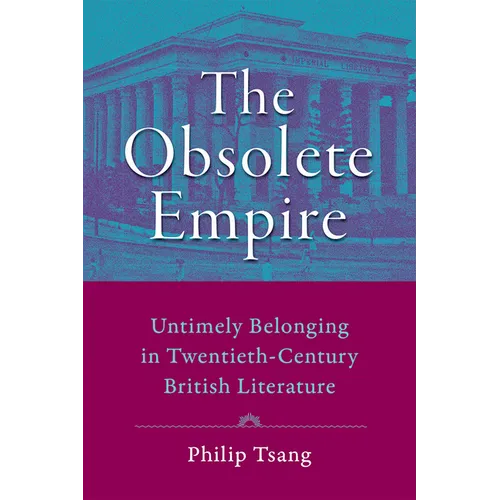
Product Description
by Philip Tsang (Author)
Modernist literature at the end of the British empire challenges conventional notions of homeland, heritage, and community.
The waning British empire left behind an abundance of material relics and an inventory of feelings not easily relinquished. In The Obsolete Empire, Philip Tsang brings together an unusual constellation of writers--Henry James, James Joyce, Doris Lessing, and V. S. Naipaul--to trace an aesthetics of frustrated attachment that emerged in the wake of imperial decline. Caught between an expansive Britishness and an exclusive Englishness, these writers explored what it meant to belong to an empire that did not belong to them.
Thanks to their voracious reading of English fiction and poetry in their formative years, all of these writers experienced a richly textured world with which they deeply identified but from which they felt excluded. The literary England they imagined, frozen in time and out of place with the realities of imperial decline, in turn figures in their writings as a repository of unconsummated attachments, contradictory desires, and belated exchanges. Their works arrest the linear progression from colonial to postcolonial, from empire to nation, and from subject to citizen. Drawing on a rich body of scholarship on affect and temporality, Tsang demonstrates how the British empire endures as a structure of desire that outlived its political lifespan.
By showing how literary reading sets in motion a tense interplay of intimacy and exclusion, Tsang investigates a unique mode of belonging arising from the predicament of being conscripted into a global empire but not desired as its proper citizen. Ultimately, The Obsolete Empire asks: What does it mean to be inside or outside any given culture? How do large-scale geopolitical changes play out at the level of cultural attachment and political belonging? How does literary reading establish or unsettle narratives of who we are? These questions preoccupied writers across Britain's former empire and continue to resonate today.
Author Biography
Philip Tsang is an assistant professor of English at Colorado State University.