Product Description
by Charles D. Carter (Author)
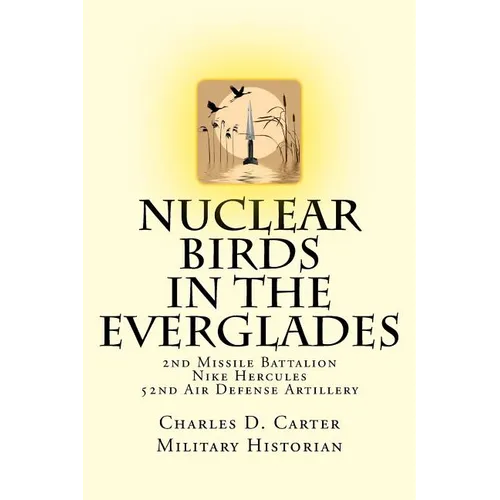
Nuclear Birds in the Everglades provides a concise narrative and photographic history of the 2nd/52nd from 1959 through 1983. A brief history is detailed of the beginnings of the Cold War followed by the events that dovetailed into the Cuban Missile Crisis including the attack on the Moncado Barracks in 1953, the revolution and overthrow of the Cuban Government in 1959, America's sanctions against Castro's Cuba in 1960, the failed CIA-sponsored Bay of Pigs Invasion, and Russia's installation of ICBMs in Cuba in 1962. America's response brings Army units that have trained and prepared for rapid-response to anywhere in the world within 72 hours. These units included the Army's 82nd and 101st Airborne units, the 1st Armored Division and a Marine division to south Florida for an invasion of Cuba. Additionally, the 2nd Nike Hercules Missile Battalion and two HAWK missile battalions create an air defense network to defend against nuclear-capable Russian IL28 Beagle bombers from Cuba. President Kennedy isolates Cuba from the rest of the world as he tightens the noose with a naval blockade. As Russia stands down and removes its ICBMs, the decision is made to keep Army air defense missiles in south Florida for an undetermined period. Now, temporary becomes permanent but with many obstacles including heat, humidity, non-stop mosquitoes, lack of electricity and running water.In a battery-by-battery chapter, it chronicles the obstacles overcome by the men and their missiles and the many positive memories for over 3000 soldiers who were stationed there between 1962 and 1979. It includes the relocation back to Ft. Bliss before being deactivated in 1983. The unit history is a means of recalling long forgotten events and rekindling ties of comradeship.The final chapter provides a detailed description of of a Florida Nike site including the configuration, the equipment and it's function. Finally, the actual firing sequence of a Nike Hercules missile.
Author Biography
About the Author: Charles D. Carter is a Cold War military historian. He entered the Army in 1962 during the outbreak of the Cuban Missile Crisis. He was assigned to the 2nd Missile Battalion 52nd ADA. Charles served as a Section Control Operator in the launch area of Battery C in Carol City and later in Key Largo at Battery B where he was honorably discharged in December 1965. Upon separation, he remained in the Army Reserves for twelve additional years. During that time he trained as a combat medic during the Vietnam War. From 1968 until 1972, he worked for IBM at Kennedy Space Center as an Aerospace Technician on the Saturn V Launch Team. There, his duties included installation of the Flight Control Computer, Guidance Computer, and Launch Vehicle Control Computer as a launch team member for all Apollo lunar landings. In 1969, he was awarded the prestigious NASA Manned Space Flight Awareness Award by Dr. Wernher von Braun. In 1972, he relocated to Atlanta, Georgia where he served in public safety for over thirty years. After an appointment as a Senior Special Assistant to the Secretary of State by the Honorable Max Cleland, former U.S. Congressman 1987, he founded the National Emergency Communications Institute (NECI) www.NECI911.com. In 2007, became a Certified Litigation Specialist and expert witness specializing in public safety lawsuits. He retired as a litigation consultant in 2012 and relocated to Palm Springs, California where he and his wife Nancy live. He was selected as a Gilman Scholar in 2014 and the Universidad de Jaen for a year to study and earn a minor degree in Spanish. while there, he continued to write Nuclear Birds in the Everglades. After he completed the academic year in Spain, he and his wife moved to a small fishing village on the Adriatic Sea in Kastel Kambelovac, Croatia. After six months of writing, he moved to Normandy, France where he continued his writing until returning to the United States in July 2016 to complete the book. He lectures and continues to write about his experiences and the history of The Cold War, Nike Hercules missiles, and the Apollo/Saturn V Space Program. The United States Army Center for Military History and Miami History Museum have published his work. He will complete his degree at California State University at age 72 in Spring of 2018.