


Product Description
by R. W. Boychuk (Author)
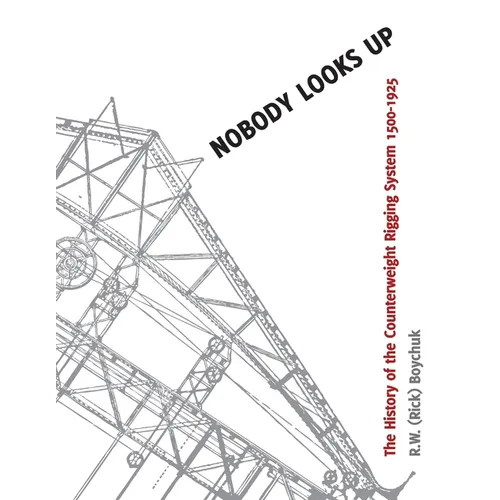
Nominated for the 2016 USITT Golden Pen Award "...a magnificent and very important piece of work for our industry." Richard Pilbrow, author of 'A Theatre Project' "Very nice job, congratulations " Mike Murphy, President, J.R. Clancy, Inc. "Boychuk has thrown down the gauntlet with bold statements backed up by documentation..." Tim Williamson, Northern Alberta Jubilee Auditorium "...a very informative and great read." Norbert Muncs, Past President, CITT "Anyone who has ever pulled a rope in the name of theatre will enjoy this revealing back story..." Charles Haines, President, Hall Stage Ltd. The counterweight rigging system has dominated the theatre fly tower for the last half of the 20th century. And yet, the history of its evolution has been lost, until now. In this first ever written history of the counterweight rigging system, author Rick Boychuk upends two core theatre myths. Stage rigging did not grow from a nautical tradition and counterweight rigging did not evolve from the hemp system. Boychuk neatly identifies the origins of the myth of the sailor-flyman and leaves no room for doubt. Counterweight rigging emerged from a European tradition of 17th century Torellian stage machinery. Hemp rigging was a side-show. In documenting the evolution of the counterweight system, Boychuk dissects the machine that is the stage house along with its upper machinery - the rigging. He examines the development of the fly tower, gridiron, loft steel, head steel, grid wells, arbor, bricks, blocks, and loft lines; all of those mundane components necessary to make the system work. He deconstructs hemp, counterweight and Torellian rigging into system paths to gain a better understanding of the progression of development and the workings of each system. This is the surprising story of how the counterweight rigging system was developed for an Austro-Hungarian theatre in 1888, then quickly found its way to the American Midwest in Adler & Sullivan's Chicago Auditorium in 1889. But it was the Chicago scenic painting studio Sosman & Landis that capitalized on the system. As Boychuk explains, Sosman & Landis adapted the system to increase the number of painted scenic pieces that they could sell to the well-funded Masonic theatres that were fast emerging across the United States. By 1925, the system had further evolved then to become crystallized in the catalogues of J.R. Clancy of Syracuse, NY. Clancy did for counterweight rigging what Ford had done for the automobile. Counterweight rigging was made affordable, was standardized and, soon, was ubiquitous in theatres around the world. A major takeaway from this book is this: the stage house impacted the evolution of stage machinery, and stage machinery impacted the evolution of the stage house. Today we appear to be witnessing a move from manual to automated stage machinery. If that is so, how will the change in our machinery impact our stage house? And how would we manage such a transition? Nobody Looks Up: The History of the Counterweight Rigging System: 1500 to 1925 is a must-read for all who work in and around technical theatre - stagehands, crew, manufacturers, designers, suppliers, consultants, and most importantly, those who are teaching the next generation of technicians. R.W. (Rick) Boychuk has been student, teacher, technical director, IA stagehand, designer and recently, inventor, and now an author. A graduate of University of Saskatchewan in technical theatre, he has worked in the industry for over 40 years. Rick owns and operates Grid Well, Inc. in Toronto, Ontario, Canada.



