


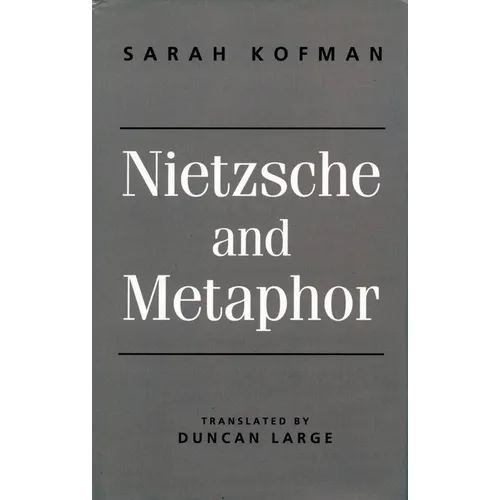
Product Description
by Sarah Kofman (Author), Duncan Large (Translator)
This long-overdue translation brings to the English-speaking world the work that set the tone for the post-structuralist reading of Nietzsche.
Back Jacket
This long-overdue translation brings to the English-speaking world the work that set the tone for the post-structuralist reading of Nietzsche.
The issue of style, of why Nietzsche wrote as he did, is fundamental, on any level, to reading his texts. Some Nietzsche critics (in particular, those, such as Jean Granier, indebted to Heidegger's reading), in effect translated Nietzsche's terms back into those of a philosophy of ontology. This book (which includes an appendix specifically directed against the "Heideggerian" reading) shows how such an approach fails to interrogate the precise terms, such as "Nature" or "life", that Nietzsche used in place of "being", and to ask the meaning of this substitution.
Dealing with all of Nietzsche's work, this book shows how he came to arrive at that position, and that to shift the question from ontology to psychology involves an important shift in the status of metaphor. The author begins with the privilege accorded to music and sound in Nietzsche's thought, to tone as an echo of the universal human pleasure and pain that serves as a foundation to all language. The Birth of Tragedy establishes a hierarchy between the different symbolic languages, which are metaphorical transpositions of the "music" of the world, itself the most appropriate representation of the innermost essence of things.
Author Biography
Sarah Kofman is Professor of Philosophy at the University of Paris I. Her most recent book to appear in English is Freud and Fiction.