Skip to content
Save 5% on your next order with code PREMIUM5!
100,000+ Products for Home, Medical, Office & Classroom Needs
Search
Skip to product information
1 of 1

Next Generation MRAM Development - Paperback

$91.76 USD
$91.76 USD
Sale Sold out
Shipping calculated at checkout.
In stock (100 units), ready to be shipped

Available Offers

Fast delivery available on most orders

Multiple secure payment options accepted

Secure checkout with
  • American Express
  • Apple Pay
  • Diners Club
  • Discover
  • Google Pay
  • Mastercard
  • PayPal
  • Shop Pay
  • Visa

Flight Range: Up to 1,000 meters (3,280 feet)

Maximum Speed: 45 kilometers per hour (28 miles per hour)

For all orders exceeding a value of 100USD shipping is offered for free.

Returns will be accepted for up to 10 days of Customer’s receipt or tracking number on unworn items. You, as a Customer, are obliged to inform us via email before you return the item.

Otherwise, standard shipping charges apply. Check out our delivery Terms & Conditions for more details.

View Product Details
Shopping cart
Product Product subtotal Quantity Price Product subtotal
Next Generation MRAM Development - Paperback
$91.76/ea
$0.00
$91.76/ea $0.00

Product Description

by Masood Qazi (Author)

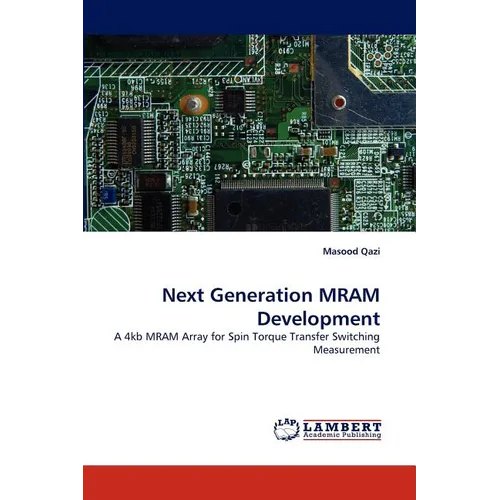
Only recently has the possibility of a universal memory, a fast random access memory that retains its state during complete power-down, turned into a realizable opportunity. Such a memory can eliminate static power, improve system reliability in the face of power interruption, and eliminate the need for a separate FLASH memory module, reducing system component count. One candidate in the race for a universal memory is magnetoresistive random access memory (MRAM). In the development of MRAM, design challenges related to isolating memory elements, obtaining a compatible operating point with CMOS technology, and sensing data reliably have emerged. Therefore, there still exists a barrier to achieving the cost and performance characteristics of traditional volatile solid state memories---SRAM and DRAM. In this work, a 4kb MRAM array is designed to evaluate the feasibility of a promising new form of MRAM based on the phenomenon of spin torque transfer switching. The design of the test site and measurement setup is discussed, showing how to explore a multidimensional parameter space of operating conditions to obtain a viable design point for the next generation of MRAM technology.

Number of Pages: 144
Dimensions: 0.34 x 9 x 6 IN
Publication Date: June 29, 2010
you might like