Product Description
by Kirk A. Gray (Author), John J. Paschkewitz (Author)
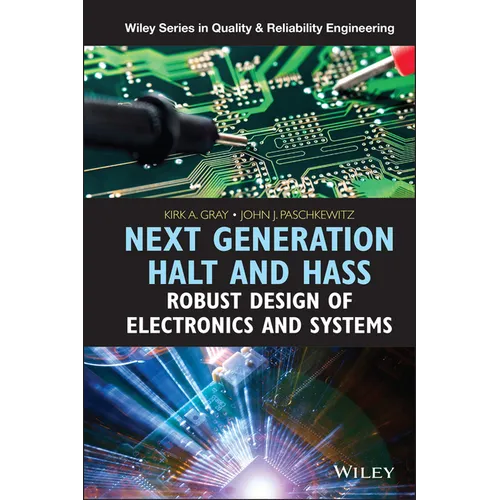
NEXT GENERATION HALT AND HASS ROBUST DESIGN OF ELECTRONICS AND SYSTEMS
A NEW APPROACH TO DISCOVERING AND CORRECTING SYSTEMS RELIABILITY RISKS
Next Generation HALT and HASS presents a major paradigm shift from reliability prediction-based methods to discovery of electronic systems reliability risks. This is achieved by integrating highly accelerated life test (HALT) and highly accelerated stress screen (HASS) into a physics of failure based robust product and process development methodology. The new methodologies challenge misleading and sometimes costly misapplication of probabilistic failure prediction methods (FPM) and provide a new deterministic map for reliability development. The authors clearly explain the new approach with a logical progression of problem statement and solutions.
The book helps engineers employ HALT and HASS by demonstrating why the misleading assumptions used for FPM are invalid. Next, the application of HALT and HASS empirical discovery methods to quickly find unreliable elements in electronics systems gives readers practical insight into the techniques.
The physics of HALT and HASS methodologies are highlighted, illustrating how they uncover and isolate software failures due to hardware-software interactions in digital systems. The use of empirical operational stress limits for the development of future tools and reliability discriminators is described.
Key features:
- Provides a clear basis for moving from statistical reliability prediction models to practical methods of insuring and improving reliability.
- Challenges existing failure prediction methodologies by highlighting their limitations using real field data.
- Explains a practical approach to why and how HALT and HASS are applied to electronics and electromechanical systems.
- Presents opportunities to develop reliability test discriminators for prognostics using empirical stress limits.
- Guides engineers and managers on the benefits of the deterministic and more efficient methods of HALT and HASS.
- Integrates the empirical limit discovery methods of HALT and HASS into a physics of failure based robust product and process development process.
Front Jacket
NEXT GENERATION HALT AND HASS ROBUST DESIGN OF ELECTRONICS AND SYSTEMS
A NEW APPROACH TO DISCOVERING AND CORRECTING SYSTEMS RELIABILITY RISKS
Next Generation HALT and HASS presents a major paradigm shift from reliability prediction-based methods to discovery of electronic systems reliability risks. This is achieved by integrating highly accelerated life test (HALT) and highly accelerated stress screen (HASS) into a physics of failure based robust product and process development methodology. The new methodologies challenge misleading and sometimes costly misapplication of probabilistic failure prediction methods (FPM) and provide a new deterministic map for reliability development. The authors clearly explain the new approach with a logical progression of problem statement and solutions.
The book helps engineers employ HALT and HASS by demonstrating why the misleading assumptions used for FPM are invalid. Next, the application of HALT and HASS empirical discovery methods to quickly find unreliable elements in electronics systems gives readers practical insight into the techniques.
The physics of HALT and HASS methodologies are highlighted, illustrating how they uncover and isolate software failures due to hardware-software interactions in digital systems. The use of empirical operational stress limits for the development of future tools and reliability discriminators is described.
Key features:
- Provides a clear basis for moving from statistical reliability prediction models to practical methods of insuring and improving reliability.
- Challenges existing failure prediction methodologies by highlighting their limitations using real field data.
- Explains a practical approach to why and how HALT and HASS are applied to electronics and electromechanical systems.
- Presents opportunities to develop reliability test discriminators for prognostics using empirical stress limits.
- Guides engineers and managers on the benefits of the deterministic and more efficient methods of HALT and HASS.
- Integrates the empirical limit discovery methods of HALT and HASS into a physics of failure based robust product and process development process.
Author Biography
Kirk A. Gray, Accelerated Reliability Solutions, LLC, Colorado, USA
John J. Paschkewitz, Product Assurance Engineering, LLC, Missouri, USA