


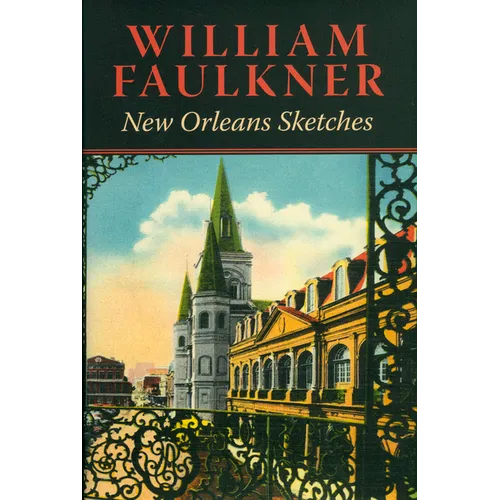
Product Description
by William Faulkner (Author), Carvel Collins (Editor)
In 1925 William Faulkner began his professional writing career in earnest while living in the French Quarter of New Orleans. He had published a volume of poetry (The Marble Faun), had written a few book reviews, and had contributed sketches to the University of Mississippi student newspaper. He had served a stint in the Royal Canadian Air Corps and while working in a New Haven bookstore had become acquainted with the wife of the writer Sherwood Anderson.
In his first six months in New Orleans, where the Andersons were living, Faulkner made his initial foray into serious fiction writing. Here in one volume are the pieces he wrote while in the French Quarter. These were published locally in the Times-Picayune and in the Double Dealer. The pieces in New Orleans Sketches broadcast seeds that would take root in later works. In their themes and motifs these sketches and stories foreshadow the intense personal vision and style that would characterize Faulkner's mature fiction. As his sketches take on parallels with Christian liturgy and as they portray such characters as an idiot boy similar to Benjy Compson, they reveal evidence of his early literary sophistication. In praise of New Orleans Sketches, Alfred Kazin wrote in the New York Times Book Review that "the interesting thing for us now, who can see in this book the outline of the writer Faulkner was to become, is that before he had published his first novel he had already determined certain main themes in his work." In his trailblazing introduction, Carvel Collins often called "Faulkner's best-informed critic," illuminates the period when the sketches were written as the time that Faulkner was making the transition from poet to novelist. "For the reader of Faulkner," Paul Engle wrote in the Chicago Tribune, "the book is indispensable. Its brilliant introduction . . . is full both of helpful information . . . and of fine insights." "We gain something more than a glimpse of the mind of a young genius asserting his power against a partially indifferent environment," states the Book Exchange (London). "The long introduction . . . must rank as a major literary contribution to our knowledge of an outstanding writer: perhaps the greatest of our times."Author Biography
William Faulkner (1897-1962) is considered one of the greatest writers of the twentieth century. His novels include The Sound and the Fury; Light in August; Absalom, Absalom!; Sanctuary; and As I Lay Dying. He was awarded the Nobel Prize for Literature in 1950. Carvel Collins (1912-1990), one of the foremost authorities on Faulkner's life and works, served on the faculties of Harvard University, Massachusetts Institute of Technology, Swarthmore College, and the University of Notre Dame, where he was the first to teach a course devoted to Faulkner's writing.