


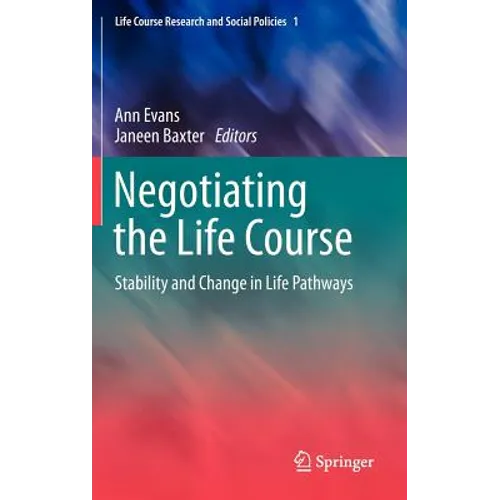
Product Description
by Ann Evans (Editor), Janeen Baxter (Editor)
Pathways through the life course have changed considerably in recent decades. Many of our assumptions about leaving home, starting new relationships and having children have been turned upside down. It is now almost as common to have children prior to marriage as afterwards, and certainly much more common to live together before marrying than to marry without first living together. Women are more likely to remain in the labour force after having children and many families struggle with problems of work-family balance at some stage in their lives, particularly when they have young children. But how much has really changed? Is there really more diversity in how individuals transition through these life course stages, or just variations at the margin with most people following a standard work and family life course?
This volume makes use of rich longitudinal data from a unique Australian project to examine these issues. Drawing on broader theories of social change and demographic transitions in an international context, each chapter provides a detailed empirical assessment of the ways in which Australian adults negotiate their work and family lives. In doing so, the volume provides important insight into the ways in which recent demographic, social and economic changes both challenge and reproduce gender divisions.
Back Jacket
Pathways through the life course have changed considerably in recent decades. Many of our assumptions about leaving home, starting new relationships and having children have been turned upside down. It is now almost as common to have children prior to marriage as afterwards, and certainly much more common to live together before marrying than to marry without first living together. Women are more likely to remain in the labour force after having children and many families struggle with problems of work-family balance at some stage in their lives, particularly when they have young children. But how much has really changed? Is there really more diversity in how individuals transition through these life course stages, or just variations at the margin with most people following a standard work and family life course?
This volume makes use of rich longitudinal data from a unique Australian project to examine these issues. Drawing on broader theories of social change and demographic transitions in an international context, each chapter provides a detailed empirical assessment of the ways in which Australian adults negotiate their work and family lives. In doing so, the volume provides important insight into the ways in which recent demographic, social and economic changes both challenge and reproduce gender divisions.



