


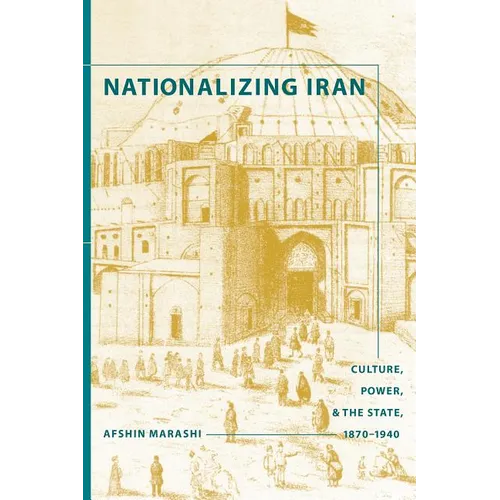
Product Description
by Afshin Marashi (Author)
When Naser al-Din Shah, who ruled Iran from 1848 to 1896, claimed the title Shadow of God on Earth, his authority rested on premodern conceptions of sacred kingship. By 1941, when Mohammad Reza Shah Pahlavi came to power, his claim to authority as the Shah of Iran was infused with the language of modern nationalism. In short, between roughly 1870 and 1940, Iran's traditional monarchy was forged into a modern nation-state.
In Nationalizing Iran, Afshin Marashi explores the changes that made possible this transformation of Iran into a social abstraction in which notions of state, society, and culture converged. He follows Naser al-Din Shah on a tour of Europe in 1873 that led to his importing a new public image of monarchy-an image based on the European late imperial model-relying heavily on the use of public ceremonies, rituals, and festivals to promote loyalty to the monarch. Meanwhile, Iranian intellectuals were reimagining ethnic history to reconcile "authentic" Iranian culture with the demands of modernity. From the reform of public education to the symbolism surrounding grand public ceremonies in honor of long-dead poets, Marashi shows how the state invented and promoted key features of the common culture binding state and society. The ideological thrust of that century would become the source of dramatic contestation in the late twentieth century.
Marashi's study of the formative era of Iranian nationalism will be valuable to scholars and students of history, sociology, political science, and anthropology, as well as journalists, policy makers, and other close observers of contemporary Iran.
Author Biography
Afshin Marashi is assistant professor of history at California State University at Sacramento.



