Product Description
by John Pitka (Author), Hillar Kalmar (Translator)
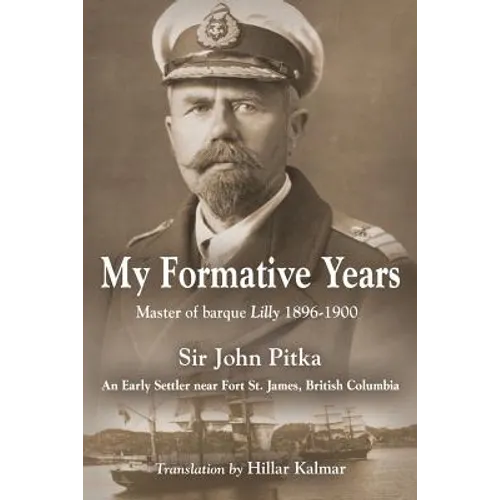
Johan Pitka (1872-1944) was born in Estonia, one of nine countries that border the Baltic Sea. Drawn to the ocean from reading tales of adventure as a child, he first saw the sea at age 12. After working aboard ships during summers and attending maritime school during winters, he earned his master's license in 1895. Pitka became captain of a wooden barque named Lilly at age 24. From 1896-1900 he made four Atlantic crossings with this cargo ship and also sailed the Caribbean, Mediterranean and Baltic Seas.
Pitka visited many countries and dozens of ports in cities, towns and remote anchorages, surviving powerful storms, mutiny and sickness. He saw wonderful scenery and wildlife, learned from other captains and perceived the intrinsic beauty of indigenous people while lamenting past actions by European nations against them. Working in different cultures and languages, he learned to deal with unscrupulous people, including merchants, harbour captains, customs officers and crewmen.
Pitka's autobiography describes his voyages aboard Lilly, giving insight to how they helped him develop the initiative, confidence, character, resourcefulness and will that he showed in later years. His narrative quotes from Charles Darwin, F.A. Mitchell-Hedges and H.P. Blavatsky.
When Lilly was sold after her owner died, Pitka worked aboard other vessels until 1907 when he co-founded a shipping agency and chandlery in Liverpool. He moved to Tallinn in 1911 to advise shipping companies and represent the Canadian Pacific Railway in the Baltics.
Pitka founded the Estonian Navy during WWI and helped to lead that country's successful War of Independence (1918-1920) against Bolshevik Russian and Baltic German forces. Appointed Rear Admiral in 1919, he received a knighthood (KCMG) from Britain's King George V in 1920.
In 1924, Pitka led a group of settlers to homestead near Fort St. James, British Columbia when about 50 Caucasians and 500 indigenous people lived in the region. This area was chosen, in part, because the B.C. government planned to extend the railway northward, but this did not happen for another 50 years. Pitka's group tried sawmilling, growing crops and raising sheep and cattle but sustainability was elusive due to the high cost of moving goods 65 km south over rugged territory to the closest railhead, and devaluation of the Canadian dollar. By 1932 all settlers had moved elsewhere, leaving their names on B.C. landmarks such as Pitka Mountain, Pitka Bay, Linda Lake, Colony Point and Paaren's Beach Provincial Park. A monument to honour Pitka was unveiled in Fort St. James in 2009.
When homesteading in B.C. proved unsustainable, Pitka returned to his homeland where he advised shipping companies, explored politics and wrote his maritime autobiography. He also translated two books from English to Estonian. The first, Ways to Perfect Health, by Irving S. Cooper (1912) was published in 1935 and the other, Excerpts from The Book of The Golden Precepts, by H.P. Blavatsky (The Voice of The Silence, 1889), was published in 1939.
During WWII, Pitka's three sons were arrested and executed by the Soviets and Pitka disappeared in 1944 while organizing resistance. His wife and two daughters escaped and returned to B.C. in 1948.
As reported in an article during the 1960's, the short duration of Pitka's settlement in British Columbia, and his romantic memories of it, reflected his personality, about which someone once said, "It was hard to know where the sailor, the soldier, the merchant, the farmer, the writer or even the artist started or ended, as he had a very sensitive soul."
Pitka was a complex man, who thought of his formative years aboard Lilly as the golden years of his youth.