Product Description
by Emmanuel Amiot (Author)
Back Jacket
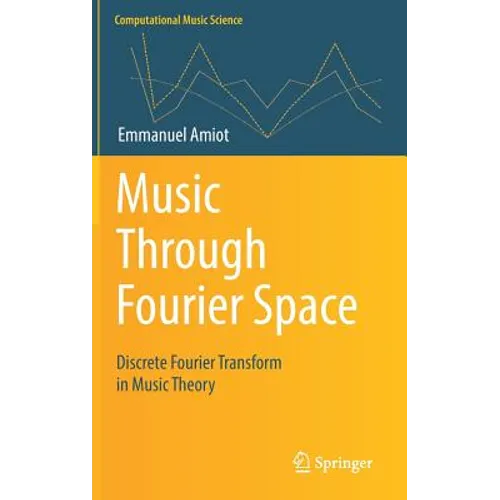
This book explains the state of the art in the use of the discrete Fourier transform (DFT) of musical structures such as rhythms or scales. In particular the author explains the DFT of pitch-class distributions, homometry and the phase retrieval problem, nil Fourier coefficients and tilings, saliency, extrapolation to the continuous Fourier transform and continuous spaces, and the meaning of the phases of Fourier coefficients.
This is the first textbook dedicated to this subject, and with supporting examples and exercises this is suitable for researchers and advanced undergraduate and graduate students of music, computer science and engineering. The author has made online supplementary material available, and the book is also suitable for practitioners who want to learn about techniques for understanding musical notions and who want to gain musical insights into mathematical problems.Author Biography
Emmanuel Amiot teaches mathematics at the Lycée François Arago in Perpignan, he is a researcher in the Laboratoire de Mathématiques et Physique (LAMPS) of Université de Perpignan Via Domitia, and he is a regular collaborator with researchers at the Institut de Recherche et Coordination Acoustique/Musique (IRCAM), Paris. He is a pioneer of the techniques described in this textbook, with considerable research and teaching experience in the related areas, geometry, topology, and applied mathematics.