


Product Description
by Hanno Sauer (Author)
An argument that moral reasoning plays a crucial role in moral judgment through episodes of rational reflection that have established patterns for automatic judgment foundation.
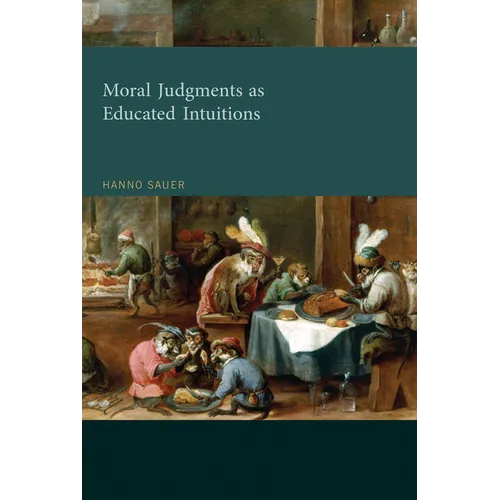
Rationalists about the psychology of moral judgment argue that moral cognition has a rational foundation. Recent challenges to this account, based on findings in the empirical psychology of moral judgment, contend that moral thinking has no rational basis. In this book, Hanno Sauer argues that moral reasoning does play a role in moral judgment--but not, as is commonly supposed, because conscious reasoning produces moral judgments directly. Moral reasoning figures in the acquisition, formation, maintenance, and reflective correction of moral intuitions. Sauer proposes that when we make moral judgments we draw on a stable repertoire of intuitions about what is morally acceptable, which we have acquired over the course of our moral education--episodes of rational reflection that have established patterns for automatic judgment foundation. Moral judgments are educated and rationally amenable moral intuitions. Sauer engages extensively with the empirical evidence on the psychology of moral judgment and argues that it can be shown empirically that reasoning plays a crucial role in moral judgment. He offers detailed counterarguments to the anti-rationalist challenge (the claim that reason and reasoning play no significant part in morality and moral judgment) and the emotionist challenge (the argument for the emotional basis of moral judgment). Finally, he uses Joshua Greene's Dual Process model of moral cognition to test the empirical viability and normative persuasiveness of his account of educated intuitions. Sauer shows that moral judgments can be automatic, emotional, intuitive, and rational at the same time.Author Biography
Hanno Sauer is Assistant Professor of Philosophy at Utrecht University.
Number of Pages: 328
Dimensions: 0.69 x 9 x 6 IN
Publication Date: November 01, 2022