


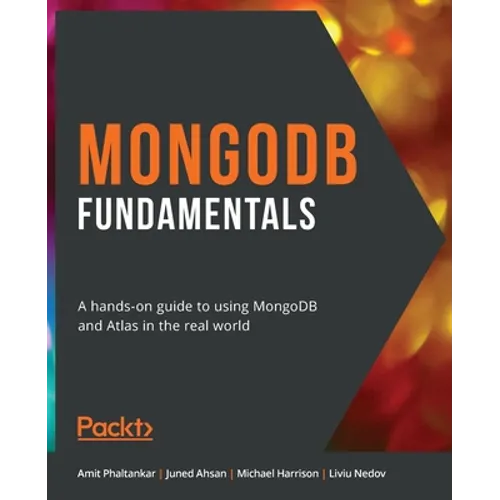
Product Description
by Amit Phaltankar (Author), Juned Ahsan (Author), Michael Harrison (Author)
Learn how to deploy and monitor databases in the cloud, manipulate documents, visualize data, and build applications running on MongoDB using Node.js
Key Features
- Learn the fundamentals of NoSQL databases with MongoDB
- Create, manage, and optimize a MongoDB database in the cloud using Atlas
- Use a real-world dataset to gain practical experience of handling big data
Book Description
MongoDB is one of the most popular database technologies for handling large collections of data. This book will help MongoDB beginners develop the knowledge and skills to create databases and process data efficiently.
Unlike other MongoDB books, MongoDB Fundamentals dives into cloud computing from the very start - showing you how to get started with Atlas in the first chapter. You will discover how to modify existing data, add new data into a database, and handle complex queries by creating aggregation pipelines. As you progress, you'll learn about the MongoDB replication architecture and configure a simple cluster. You will also get to grips with user authentication, as well as techniques for backing up and restoring data. Finally, you'll perform data visualization using MongoDB Charts.
You will work on realistic projects that are presented as bitesize exercises and activities, allowing you to challenge yourself in an enjoyable and attainable way. Many of these mini-projects are based around a movie database case study, while the last chapter acts as a final project where you will use MongoDB to solve a real-world problem based on a bike-sharing app.
By the end of this book, you'll have the skills and confidence to process large volumes of data and tackle your own projects using MongoDB.
What You Will Learn
- Set up and use MongoDB Atlas on the cloud
- Insert, update, delete, and retrieve data from MongoDB
- Build aggregation pipelines to perform complex queries
- Optimize queries using indexes
- Monitor databases and manage user authorization
- Improve scalability and performance with sharding clusters
- Replicate clusters, back up your database, and restore data
- Create data-driven charts and reports from real-time data
Who this book is for
This book is designed for people who are new to MongoDB. It is suitable for developers, database administrators, system administrators, and cloud architects who are looking to use MongoDB for smooth data processing in the cloud. Although not necessary, basic knowledge of a general programming language and experience with other databases will help you grasp the topics covered more easily.