


Product Description
by Arieh Ben-Naim (Author)
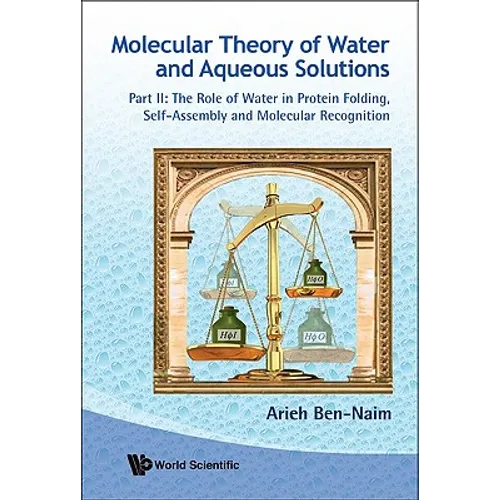
This book starts out by presenting the evidence for the importance of hydrophilic interactions in biochemical processes and then goes on to describe the applications of the hydrophilic interactions in these processes, specifically protein folding, protein association, self assembly and molecular recognition.In this volume it is shown that the new paradigm, based on the hydrophilic effect, brings us as close as one can hope to the solutions of the protein folding problem, as well as the problem of self assembly and molecular recognition. In addition, the new paradigm also provides an explanation of the high solubility of globular proteins.The change in the paradigm is shown symbolically in the cover design of this book.
Front Jacket
This book starts out by presenting the evidence for hydrophilic interactions in biochemical processes and then goes on to describe the applications of the hydrophilic interactions in these processes, specifically protein folding, protein association, self assembly and molecular recognition.
In Part I of this series, it was shown that the role of the so-called hydrophobic effect in biochemical processes was over-exaggerated. On the other hand, both experimental data and theoretical arguments support the conclusion that the hydrophilic, rather than hydrophobic interactions are the more important effects. In this volume, the author focuses on the applications of the hydrophilic interactions in processes such as solubility of proteins, protein folding, self assembly and molecular recognition. Hydrophilic interactions provide a powerful and coherent explanation of some biochemical processes, which until recently, were not understood.
There are no other books of this kind. There are two books which deal with the role of hydrophobic effects (by C Tanford and A Ben-Naim), but these are quite obsolete.



