Product Description
by Adam C. Stanley (Author)
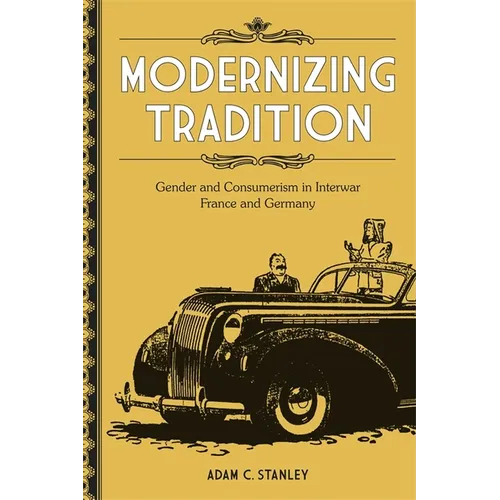
In the turbulent decades after World War I, both France and Germany sought to return to an idealized, prewar past. Many people believed they could recapture a sense of order and stability by reinstituting traditional gender roles, which the war had thrown off balance. While French and German women necessarily filled men's roles in factories and other jobs during the war, those who continued to lead active working lives after World War I risked being called "modern women." Far from a compliment, this derogatory label encompassed everything society found threatening about women's new place in public life: smoking, working women who preferred independence and sexual freedom to a traditional role in the home. Society felt threatened by the image of the "modern woman," yet also realized that conceptions of femininity needed to accommodate the cultural changes brought about by the Great War.
In Modernizing Tradition, Adam C. Stanley explores how interwar French and German popular culture used commercial images to redefine femininity in a way that granted women some access to modern life without encouraging the assertion of female independence. Examining advertisements, articles, and cartoons, as well as department store publicity materials from the popular press of each nation, Stanley reveals how the media attempted to convince women that--with the help of newly available consumer goods such as washing machines, refrigerators, and vacuum cleaners--being a mother or a housewife could be empowering, even liberating. A life devoted to the home, these images promised, need not be an unmitigated return to old-fashioned tradition but could offer a rewarding lifestyle based on the wonders and benefits of modern technology. Stanley shows that the media carefully limited women's association with modernity to those activities that reinforced women's traditional roles or highlighted their continued dependence on masculine guidance, expertise, and authority.
In this cross-national study, Stanley brings into sharp relief issues of gender and consumerism and reveals that, despite the larger political differences between France and Germany, gender ideals in the two countries remained virtually identical between the world wars. That these concepts of gender stayed static over the course of two decades--years when nearly every other aspect of society and culture seemed to be in constant flux--attests to their extraordinary power as a force in French and German society.
Author Biography
Adam C. Stanley is an assistant professor of history at the University of Wisconsin, Platteville.