Skip to content
Save 5% on your next order with code PREMIUM5!
100,000+ Products for Home, Medical, Office & Classroom Needs
Search
Skip to product information
1 of 1

Modeling of Organic Carbon in the Sediments of Mangrove Wetlands - Paperback

$105.59 USD
$105.59 USD
Sale Sold out
Shipping calculated at checkout.
In stock (100 units), ready to be shipped

Available Offers

Fast delivery available on most orders

Multiple secure payment options accepted

Secure checkout with
  • American Express
  • Apple Pay
  • Diners Club
  • Discover
  • Google Pay
  • Mastercard
  • PayPal
  • Shop Pay
  • Visa

Flight Range: Up to 1,000 meters (3,280 feet)

Maximum Speed: 45 kilometers per hour (28 miles per hour)

For all orders exceeding a value of 100USD shipping is offered for free.

Returns will be accepted for up to 10 days of Customer’s receipt or tracking number on unworn items. You, as a Customer, are obliged to inform us via email before you return the item.

Otherwise, standard shipping charges apply. Check out our delivery Terms & Conditions for more details.

View Product Details
Shopping cart
Product Product subtotal Quantity Price Product subtotal
Modeling of Organic Carbon in the Sediments of Mangrove Wetlands - Paperback
$105.59/ea
$0.00
$105.59/ea $0.00

Product Description

by Lakshumanan C (Author), Usha Natesan (Author)

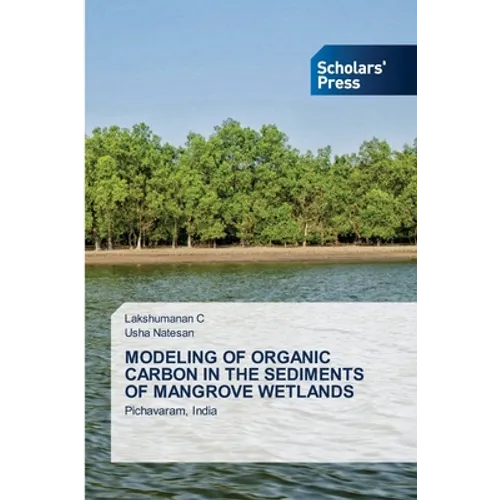
Mangroves are highly productive and they serve as a vital source for Organic Carbon in the sediments. The study area, Pichavaram mangrove is located along the southeast coast of India. This mangrove environment is rapidly degrading due to natural and man-made disturbances. In order to understand the temporal and spatial changes in the mangrove forest, Landuse / Landcover change detection was carried out for this area using satellite digital data. Five Core samples were collected from widely varying environments in the study area along with twenty surface sediments and twenty water samples. The Core samples were analyzed for grain size, Organic Carbon, Sulphur, Calcium Carbonate, acid-leachable fractions of Fe and Mn, major oxides and bulk concentration of Fe, Mn, Cr, Cu and Zn. Similar to the Core sediments, the surface sediment samples were analyzed for major oxides and trace elements. The water samples were analyzed for pH, Salinity and Dissolved Oxygen. An Organic Carbon budget was developed based on the depth profile of Organic Carbon. Results of all the above analyses were digitized using GIS and a spatial database was created.

Number of Pages: 144
Dimensions: 0.34 x 9 x 6 IN
Publication Date: April 24, 2021
you might like