


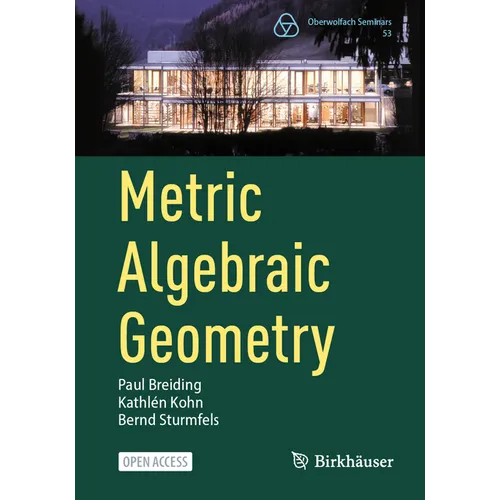
Product Description
by Paul Breiding (Author), Kathlén Kohn (Author), Bernd Sturmfels (Author)
Metric algebraic geometry combines concepts from algebraic geometry and differential geometry. Building on classical foundations, it offers practical tools for the 21st century. Many applied problems center around metric questions, such as optimization with respect to distances.
After a short dive into 19th-century geometry of plane curves, we turn to problems expressed by polynomial equations over the real numbers. The solution sets are real algebraic varieties. Many of our metric problems arise in data science, optimization and statistics. These include minimizing Wasserstein distances in machine learning, maximum likelihood estimation, computing curvature, or minimizing the Euclidean distance to a variety.
This book addresses a wide audience of researchers and students and can be used for a one-semester course at the graduate level. The key prerequisite is a solid foundation in undergraduate mathematics, especially in algebra and geometry.
This is an openaccess book.
Back Jacket
Metric algebraic geometry combines concepts from algebraic geometry and differential geometry. Building on classical foundations, it offers practical tools for the 21st century. Many applied problems center around metric questions, such as optimization with respect to distances.
After a short dive into 19th-century geometry of plane curves, we turn to problems expressed by polynomial equations over the real numbers. The solution sets are real algebraic varieties. Many of our metric problems arise in data science, optimization and statistics. These include minimizing Wasserstein distances in machine learning, maximum likelihood estimation, computing curvature, or minimizing the Euclidean distance to a variety.
This book addresses a wide audience of researchers and students and can be used for a one-semester course at the graduate level. The key prerequisite is a solid foundation in undergraduate mathematics, especially in algebra and geometry.
This is an open access book.
Author Biography
Paul Breiding is professor for mathematical methods in data science at the University of Osnabrück, an Emmy-Noether Research Group Leader and member of the Academy of Sciences and Literature Mainz. In 2021 he received the Early Career Prize of the SIAM Activity Group on Algebraic Geometry. His interests lie in numerical and random algebraic geometry. He is one of the developers of the software HomotopyContinuation.jl.
Kathlén Kohn is a tenure-track assistant professor at KTH in Stockholm. Her research investigates the underlying geometry in computer-vision, machine-learning and statistical problems, using algebraic methods. For her research in computer vision, she received the Best Student Paper Award at the International Conference on Computer Vision (ICCV) in 2019 and the Swedish L'Oréal-Unesco for Women in Science prize in 2023.
After many years at UC Berkeley, Bernd Sturmfels now serves as a director at the Max-Planck Institute for Mathematics in the Sciences in Leipzig, Germany, where he leads the Nonlinear Algebra group. He has published 10 books and 300 articles, and he mentored 60 doctoral students, plus countless postdocs. His interests range from algebraic geometry and combinatorics to statistics, optimization and physics.