


Product Description
by Robert Pippin (Author)
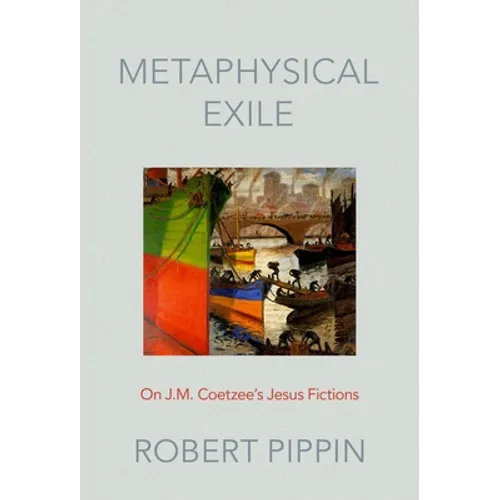
Nobel Prize-winning novelist J.M. Coetzee's "Jesus" fictions constitute a trilogy of novels that have appeared over the last decade. They stand out from his earlier work in their difficulty, and in the central role they accord philosophy--in part through their interest in specific themes in which philosophy is interested, in part through their critical engagement with philosophy as a mode of intellectual activity, with a very particular role to play in the broader cultural concerns of modern Western Europe.
Robert Pippin presents the first detailed interpretation of J.M. Coetzee's "Jesus" trilogy as a whole. In order to understand them, he treats the three fictions as a philosophical fable, in the tradition of Plato's Republic, More's Utopia, Rousseau's Emile, or Nietzsche's Thus Spoke Zarathustra. In the trilogy's mythical setting, everyone is an exile, removed from their homeland and transported to a strange new place, with most of their memories of their homeland erased. Pippin treats these fictions as philosophical explorations of the implications of a deeper kind of spiritual homelessness--a version that characterizes late modern life itself--and he sees the theme of forgetting as a figure for modern historical amnesia and indifference to reflection and self-knowledge. This state of exile is interpreted as metaphysical as well as geographical. Pippin's insightful, careful reading of Coetzee suggests the limitations of traditional philosophical treatments of themes like eros, beauty, social order, art, family, non-discursive forms of intelligibility, self-deception, and death. And he wrings from the trilogy its intertextuality, and many references to the Christian Bible, Plato, Cervantes, Goethe, Kleist, and Wittgenstein, among others. Throughout, Pippin expresses the potential of literature to be a profound form of philosophical reflection.Author Biography
Robert B. Pippin is the Evelyn Stefansson Nef Distinguished Service Professor at the University of Chicago. He is the author of several books on modern German philosophy, a book on philosophy and literature, Henry James and Modern Moral Life (Cambridge University Press, 2001); a book on modernist art, After the Beautiful (University of Chicago Press, 2013), and five books on film and philosophy. He is a past winner of the Mellon Distinguished Achievement Award in the Humanities, a Guggenheim Fellowship, is a fellow of the American Academy of Arts and Sciences, of the American Philosophical Society, and is a member of the German National Academy of Sciences, Leopoldina. His latest books are Hegel's Realm of Shadows: Logic as Metaphysics in The Science of Logic (University of Chicago Press, 2018), and Filmed Thought: Cinema as Reflective Form (University of Chicago Press, 2020).