Product Description
by Paul F. Mecham (Author)
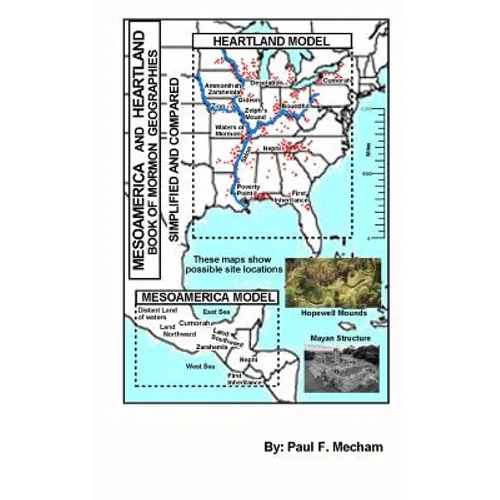
The Bible published by the Church of Jesus Christ of Latter-day Saints has maps and pictures of the Sea of Galilee, the Jordan River, Jerusalem, Rome, Athens, Egypt, Mount Sinai, Mount of Olives, Traditional Garden of Gethsemane, possible Golgotha, possible Garden Tomb, etc. Many of these are generally agreed upon, even by secular historians. The Book of Mormon currently has none of these things. There is no unanimity on geography, even among Church members. The author has had several Church leadership positions. In those roles, he has been approached with difficult questions about Book of Mormon geography. They would ask him, on the map, why is the Sea East on the North? How can there be two Hill Cumorahs? Is the Promised Land really in Guatemala? Over the years, he would meekly say something like, I have wondered about that myself. He didn't want to appear to be the official spokesman for the Church. Nor did he want to appear to be speaking against the Church. In his own pondering, he has struggled with the unknowns and the inconsistencies. He has struggled especially with the claims that Joseph Smith changed his mind over time about Central America. He would usually end up saying to himself, the Book of Mormon is still true and Joseph Smith is still a prophet. He would sometimes rationalize by thinking that maybe geography is just not that important. In 2004, the Church officially stated that they take no position on any proposed Book of Mormon sites. The Church chose to not endorse the predominant theory about Central America. Knowing that Church position, he now didn't feel obligated to either avoid or support wrong answers to the difficult questions. The Church also chose not to endorse any other theory. Anyone can now investigate Book of Mormon geography without any pangs of guilt. And, more importantly, anyone can investigate with the real hope of finding truth. Anyone can apply Moroni's test to find the "truth of ALL things." The author of this small paper has had John L. Sorenson's Book of Mormon geography books in his possession for literally decades. He also has books of multiple other geography theories. The Heartland documents in his possession, however, are more recent acquisitions. He does not, however, consider himself an expert by any measure. For this paper, he selected for evaluation and comparison, two geographic models from the many that have been proposed. The two have a number of things in common and yet contradict each other in a few major ways. He extensively quoted the Scriptures and the proponents of both models. This resulting paper documents mostly the differences. In addition to plainly describing these differences in some detail, he draws some interesting conclusions that he believes are consistent with the scriptures, world history and with available archeology. He believes that the information is now becoming available (much of this is contained or referenced in this paper) to resolve the major geography questions. He foresees a genuine possibility of there becoming real unanimity among Church members on Book of Mormon geography.
Author Biography
A brief list of the background/blessings received by the author, Paul F. Mecham - Born in 1937 in Salt Lake City, Utah - Married Joan Pincock Mecham in 1957 - 7 Children, 23 Grand Children, 24 Great Grand Children Adding 17 in-law spouses gives total posterity of 71 - Bachelors Degree from University of Utah 1960 - 8+ years officer in US Air Force including 98 B-52 Combat Missions over Viet Nam - Masters Degree from University of Southern California 1969 - Counselor to 3 Bishops in 3 different wards and cities, totaling 7 years - Worked for 3 different firms for about 5 years each in administration and personnel - Elected to Utah House of Representatives for 2 terms, 1979-1982 - Worked for Utah Division of Public Utilities for 20 years - High Councilor in 2 different stakes and cities - Gospel Doctrine instructor in 3 different wards and cities - Counselor to Stake President for 9 years - Stake President for 9+ years - Bishop for 5+ years - Brief times Executive Secretary to 2 different Stake Presidents - Full time proselyting missionary in Maine with wife for 1 year, 2006-2007 - Set-apart Ordinance Worker in Jordan River Temple for 9 years, 2007-2016 - Current calling: Stake Patriarch for nearly 5 years, 2011 to present