


Product Description
by William B. Dillingham (Author)
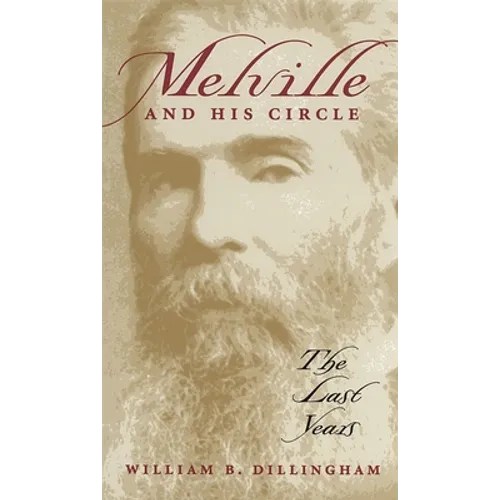
Herman Melville is a towering figure in American literature--arguably the country's greatest nineteenth-century writer. Revising a number of entrenched misunderstandings about Melville in his later years, this is a remarkable and unprecedented account of the aged author giving himself over to a life of the mind. Focusing exclusively on a period usually associated with the waning of Melville's literary powers, William B. Dillingham shows that he was actually concentrating and intensifying his thoughts on art and creativity to a greater degree than ever before.
Biographers have written little about Melville's deceptively "quiet" years after the publication of the long poem Clarel in 1876 and before his death in 1891. It was a time when he saw few friends or acquaintances, answered most of his letters as briefly as possible, and declined most social invitations. But for Melville, as for Emily Dickinson, such outward appearances belied an intense, engaged inner life. If for no other reason, Dillingham reminds us, this period merits more discerning attention because it was then that Melville produced Billy Budd as well as an impressive number of new and revised poems--while working full-time as a customs inspector for more than half of those years. What sustained Melville during that final period of ill health and near-poverty, says Dillingham, was his "circle," not of close friends but of works by a number of writers that he read with appreciative, yet discriminating, affinity, including Matthew Arnold, James Thomson, Arthur Schopenhauer, and Honore de Balzac. Dillingham relates these readings to Melville's own poetry and prose and to a rich variety of largely underappreciated topics relevant to Melville's later life, from Buddhism, the School of Pessimism, and New York intellectual life to Melville's job at the ever-corrupt customs house, his fear of disgrace and increased self-absorption, and his engagement with both the picturesque and the metaphorical power of roses in art and literature. This portrait of the great writer's final years is at once a biography, an intellectual history, and a discerning reading of his mature work. By showing that Melville's isolation was a conscious intellectual decision rather than a psychological quirk, Melville and His Circle reveals much that is new and challenging about Melville himself and about our notions of age and the persistence of imagination and creativity.Back Jacket
Herman Melville is a towering figure in American literature - arguably the country's greatest nineteenth-century writer. Revising a number of entrenched misunderstandings about Melville in his later years, this is a remarkable and unprecedented account of the aged author giving himself over to a life of the mind. Focusing exclusively on a period usually associated with the waning of Melville's literary powers, William B. Dillingham shows that he was actually concentrating and intensifying his thoughts on art and creativity to a greater degree than ever before. What sustained Melville during that final period of ill health and near-poverty, says Dillingham, was his "circle", not of close friends but of works by a number of writers that he read with appreciative, yet discriminating, affinity, including Matthew Arnold, James Thomson, Arthur Schopenhauer, and Honore de Balzac. Dillingham relates these readings to Melville's own poetry and prose and to a rich variety of largely under-appreciated topics relevant to Melville's later life, from Buddhism, the School of Pessimism, and New York intellectual life to Melville's job at the ever-corrupt customs house, his fear of disgrace and increased self-absorption, and his engagement with both the picturesque and the methaphorical power of roses in art and literature. This portrait of the great writer's final years is at once a biography, an intellectual history, and a discerning reading of his mature work. By showing that Melville's isolation was a conscious intellectual decision rather than a psychological quirk, Melville and His Circle reveals much that is new and challenging about Melville himself and about our notions of age and thepersistence of imagination and creativity.
Author Biography
WILLIAM B. DILLINGHAM is Charles Howard Candler Professor of American Literature at Emory University. His books include An Artist in the Rigging: The Early Work of Herman Melville and Melville's Short Fiction, 1853-1856 (both Georgia).



