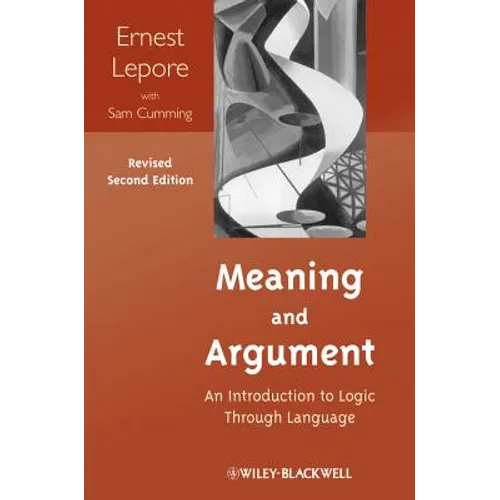
Product Description
by Ernest Lepore (Author), Sam Cumming (Author)
Meaning and Argument is a popular introduction to philosophy of logic and philosophy of language.
- Offers a distinctive philosophical, rather than mathematical, approach to logic
- Concentrates on symbolization and works out all the technical logic with truth tables instead of derivations
- Incorporates the insights of half a century's work in philosophy and linguistics on anaphora by Peter Geach, Gareth Evans, Hans Kamp, and Irene Heim among others
- Contains numerous exercises and a corresponding answer key
- An extensive appendix allows readers to explore subjects that go beyond what is usually covered in an introductory logic course
- Updated edition includes over a dozen new problem sets and revisions throughout
- Features an accompanying website at http: //ruccs.rutgers.edu/ logic/MeaningArgument.html
Front Jacket
Meaning and Argument shifts introductory logic from the traditional emphasis on proofs to the symbolization of arguments. Another of its distinctive features is that it shows how the need for expressive power and for drawing distinctions forces formal language development. This volume is ideal as an introduction to formal logic, philosophical logic, and philosophy of language. At each stage of system elaboration and development, the book answers meta-logical questions. Why is a particular formalism needed? What must go into such a formalism and why? These questions engage students in a collective inquiry which allows them to see logical studies as a human enterprise aimed at achieving well understood goals - clarity and good reasoning. The second edition extends and systematizes the account of anaphora, including donkey anaphora, plural anaphora, and cross-sentential anaphora. It also has additional sections on counter-models and semantics, and contains additional exercises and an updated bibliography. This update of the second edition includes over a dozen additional problem sets and revisions throughout.
Back Jacket
Meaning and Argument shifts introductory logic from the traditional emphasis on proofs to the symbolization of arguments. Another of its distinctive features is that it shows how the need for expressive power and for drawing distinctions forces formal language development. This volume is ideal as an introduction to formal logic, philosophical logic, and philosophy of language. At each stage of system elaboration and development, the book answers meta-logical questions. Why is a particular formalism needed? What must go into such a formalism and why? These questions engage students in a collective inquiry which allows them to see logical studies as a human enterprise aimed at achieving well understood goals - clarity and good reasoning. The second edition extends and systematizes the account of anaphora, including "donkey" anaphora, plural anaphora, and cross-sentential anaphora. It also has additional sections on counter-models and semantics, and contains additional exercises and an updated bibliography. This update of the second edition includes over a dozen additional problem sets and revisions throughout.
Author Biography
Ernest Lepore is Director of the Center for Cognitive Science at Rutgers University. He is the author of numerous articles in philosophy of mind and is co-author (with Herman Cappelen) of Insensitive Semantics (Blackwell, 2004), co-author (with Jerry Fodor) of Holism (Blackwell, 1991). He is editor of Truth and Interpretation (Blackwell, 1989). He is co-editor (with Zenon Pylyshyn) of What is Cognitive Science? (Blackwell, 1999), and co-editor (with Robert Van Gulick) of John Searle and His Critics (Blackwell, 1992), as well as general editor of the series Philosophers and Their Critics, also published by Wiley-Blackwell.
Sam Cumming is Assistant Professor of Philosophy at the University of California, Los Angeles.