Product Description
by Dean E. Arnold (Author)
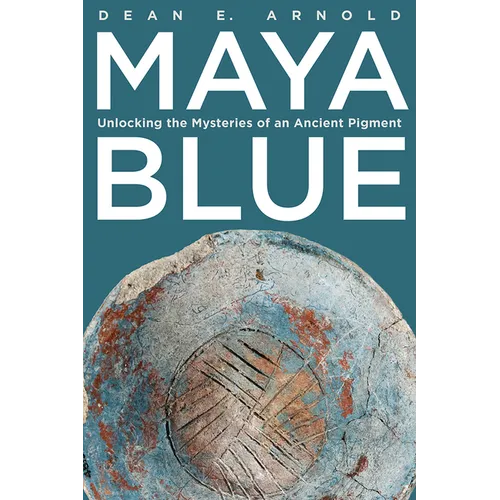
One of the great technological achievements of the ancient Maya, Maya Blue is one the world's most unusual ancient pigments. In Maya Blue, Dean E. Arnold offers a comprehensive history of its study for almost a century, filled with personal anecdotes drawn from his decades of work uncovering the Maya knowledge of its constituents, its ancient sources, and how it was made-including previously unknown methods. The book presents a fresh holistic perspective that documents these discoveries and the scientific process that led to them and provides testable hypotheses about how the pigment and the technology used to make it moved throughout Mesoamerica.
Combining the organic dye indigo and the inorganic clay mineral palygorskite in a highly stable chemical hybrid that, unlike indigo, resists attacks by acids, alkalines, and organic solvents and endures without fading, Maya Blue has a rich blue color that has survived for centuries in one of the world's harshest climates. First used at the site of Calakmul in the tropical forest of southern Mexico during the Late Preclassic period, the Maya's abiding hue diffused across Mesoamerica over a period of 1,700 years. It appears on Maya pottery, sculpture, murals, and codices and carries multiple meanings, standing as a symbol for cultural cornerstones such as sacrifice and the rain god Chaak. It was discovered in 1931 at Chichén Itzá, and its composition was a mystery for more than three decades, then questions about its source, how and why it achieved such stability, and how and why the Maya made the pigment persisted even longer. In Maya Blue, Arnold summarizes ethnographic, archaeological, chemical, and material science research over the last century from an anthropological perspective. This thorough, engaging, and accessible book chronicles the history of this pigment as no work has done before.Author Biography
Dean E. Arnold is adjunct curator of anthropology at the Field Museum of Natural History in Chicago and professor emeritus of anthropology at Wheaton College in Illinois, where he taught for thirty-nine years. He has done fieldwork in Peru, Mexico, Bolivia, Guatemala, and the Southwest; authored six books, including the seminal Ceramic Theory and Cultural Process; coedited two books; and published more than sixty articles about potters, pottery, and pottery production and related subjects (such as Maya Blue). Arnold was a Fulbright Scholar in Mexico and Peru, a visiting fellow at Clare Hall at University of Cambridge in 1985, and a visiting scholar at the Department of Archaeology there in 1985, 1992, and 2000. He received the Society for American Archaeology's Award for Excellence in Ceramic Studies in 1996.