


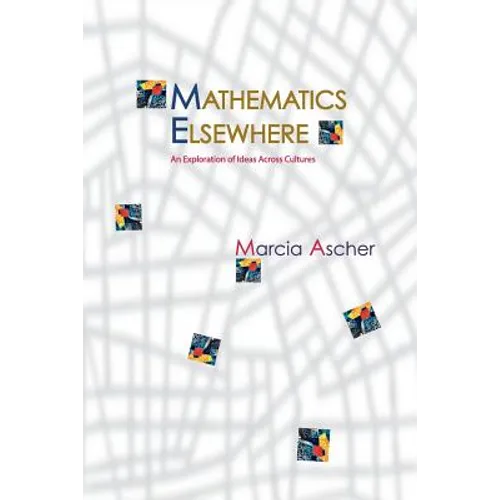
Product Description
by Marcia Ascher (Author)
Mathematics Elsewhere is a fascinating and important contribution to a global view of mathematics. Presenting mathematical ideas of peoples from a variety of small-scale and traditional cultures, it humanizes our view of mathematics and expands our conception of what is mathematical.
Through engaging examples of how particular societies structure time, reach decisions about the future, make models and maps, systematize relationships, and create intriguing figures, Marcia Ascher demonstrates that traditional cultures have mathematical ideas that are far more substantial and sophisticated than is generally acknowledged. Malagasy divination rituals, for example, rely on complex algebraic algorithms. And some cultures use calendars far more abstract and elegant than our own. Ascher also shows that certain concepts assumed to be universal--that time is a single progression, for instance, or that equality is a static relationship--are not. The Basque notion of equivalence, for example, is a dynamic and temporal one not adequately captured by the familiar equal sign. Other ideas taken to be the exclusive province of professionally trained Western mathematicians are, in fact, shared by people in many societies. The ideas discussed come from geographically varied cultures, including the Borana and Malagasy of Africa, the Tongans and Marshall Islanders of Oceania, the Tamil of South India, the Basques of Western Europe, and the Balinese and Kodi of Indonesia. This book belongs on the shelves of mathematicians, math students, and math educators, and in the hands of anyone interested in traditional societies or how people think. Illustrating how mathematical ideas play a vital role in diverse human endeavors from navigation to social interaction to religion, it offers--through the vehicle of mathematics--unique cultural encounters to any reader.Back Jacket
"Ascher's Ethnomathematics was excellent--a real landmark--and this book is at least as good. It makes us realize that our way of looking at mathematics can be completely different from those in other cultures. A wonderful book."--Peter Cameron, University of London
"This is a significant contribution to the recognized but still-emerging field of ethnomathematics. Its publication expands the available examples of mathematical ideas in traditional societies. In addition to being of interest to readers who look to the connection between culture and the development of ideas, this book should be of interest to educators at all levels who want to introduce students to diverse mathematical ideas."--Rick Scott, New Mexico State University
"Learning how others interpret time and space is extremely vital for citizenship in a globalized society. This book helps us understand how our neighbors and colleagues in an increasingly diverse world solve problems. This is a valuable and greatly needed book."--Daniel Clark Orey, Ph.D., California State University, Sacramento
Author Biography
Marcia Ascher is Professor Emerita of Mathematics at Ithaca College. She is the coauthor of Code of the Quipu: A Study in Media, Mathematics, and Culture and the author of Ethnomathematics: A Multicultural View of Mathematical Ideas.



