Product Description
by Andrew Barry (Author)
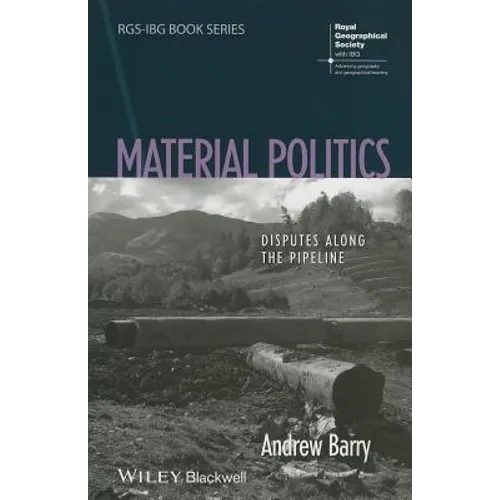
In Material Politics, author Andrew Barry reveals that as we are beginning to attend to the importance of materials in political life, materials has become increasingly bound up with the production of information about their performance, origins, and impact.
- Presents an original theoretical approach to political geography by revealing the paradoxical relationship between materials and politics
- Explores how political disputes have come to revolve not around objects in isolation, but objects that are entangled in ever growing quantities of information about their performance, origins, and impact
- Studies the example of the Baku-Tbilisi-Ceyhan oil pipeline - a fascinating experiment in transparency and corporate social responsibility - and its wide-spread negative political impact
- Capitalizes on the growing interdisciplinary interest, especially within geography and social theory, about the critical role of material artefacts in political life
Back Jacket
Geography and social theory are increasingly recognising the critical role of material artefacts in political life. No longer can we think of materials as the passive, stable and inert foundation on which disputes emerge; rather, the unpredictable and lively behaviour of material objects and environments has become integral to the conduct of politics. In Material Politics, Andrew Barry develops this argument further, directing us towards an intriguing paradox. For just as we are beginning to attend to the importance of materials in political life, the existence of materials has become increasingly bound up with the production of information about their performance, origins and impact. Political disputes have come to revolve not around objects in isolation, but objects that are entangled in ever growing quantities of information.
Material Politics traces the emergence of disputes about an object, an oil pipeline, about which an unprecedented quantity of information was made public. Following the collapse of the Soviet Union, the development of the 1760km Baku-Tbilisi-Ceyhan pipeline from the Caspian Sea to the Mediterranean was a remarkable experiment in transparency and corporate social responsibility. Yet far from reducing the level of controversy surrounding the pipeline's construction, the transparency of the project engendered a proliferation of apparently minor disputes about issues ranging from public consultation procedures and the location of beehives and walnut trees to the putative connection between the construction of the pipeline and bombsites, landslides and damage to houses. The politics of the pipeline turns out to be not just a story of oil companies, nation states and activists; it also encompasses consultants' and engineers' reports, archaeological sites, documentary films, steel and chemicals, cracks and corrosion, and mundane objects - trees, lorries and houses. Materials, we might say, lie at the heart of the eruption of situations that both animate and transform political life.
Author Biography
Andrew Barry is Professor of Human Geography at University College London.