Product Description
by Zedong Mao (Author), Stuart Schram (Author)
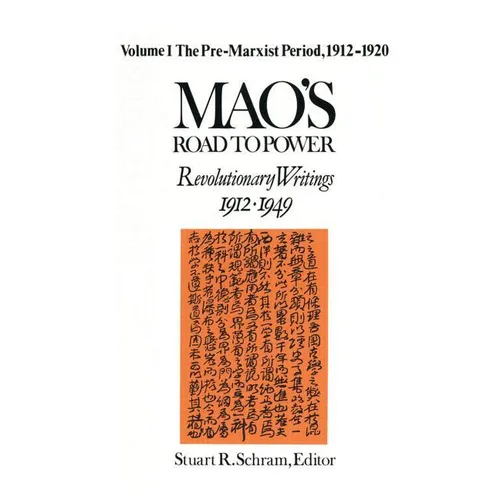
Revolution in its Leninist guise has been a dominant force in the world for most of the 20th century, and the Chinese revolution has been, with the Russian revolution, one of its two most important manifestations. Mao Zedong, the architect of victory in China in 1949, stands out as one of the dominant figures of the century. Guerilla leader, strategist, conqueror, ruler, poet and philosopher, he placed his imprint on China, and on the world. Even though today communism is widely seen as bankrupt, Mao Zedong's achievements as an innovative disciple of Lenin and Stalin in the most populous nation on earth guarantees his place in history. Whatever the ultimate fate of communism in China, the fact of Mao's influence on events during more than five decades, and its resonance after his death, will remain. This edition of Mao Zedong's writings provides abundant documentation in his own words regarding his life and thought. It has been compiled from all available Chinese sources, including not only the 20-volume edition published in Tokyo years ago, but many new materials issued in China since 1978, both openly and for internal circulation. The editors have pursued a threefold goal: firstly, to translate every text by Mao which could be obtained, so as to make this English version as complete as possible; secondly, to annotate the materials in sufficient detail to make them accessible to the non-specialist reader; and thirdly, to combine accuracy with a level of literary quality which is intended to make the volumes agreeable as well as instructive to read. Volume 1 includes translations of the entire contents of the authoritative "Mao Zedong Zaoqi Wengao 1912.6-1920.11" ("Draft writings from Mao Zedong's early period, June 1912-November 1920"), published in Beijing in 1990, plus some 15 additional texts for the same period which have been attributed to Mao. Among the items thus made available in English are his first surviving work, a middle school essay of 1912 in praise of Shang Yang; his very extensive "Classroom Notes" of late 1913 on the lectures of his most influential teachers, Yang Changji and "Yuan the Big Beard"; a dozen letters to his then close friend Xiao Zisheng (Siao-yu), who described a shared odyssey in "Mao-Tse-tung and I were Beggars"; his marginal annotations of 1918 to the German philosopher Friedrich Paulsen's work on ethics, in which Mao proclaimed himself a believer in "individualism" and an admirer of Nietzsche; and many important letters, articles, and other writings documenting his evolution from liberalism to anarchism and finally to Marxism in 1919-1920.