


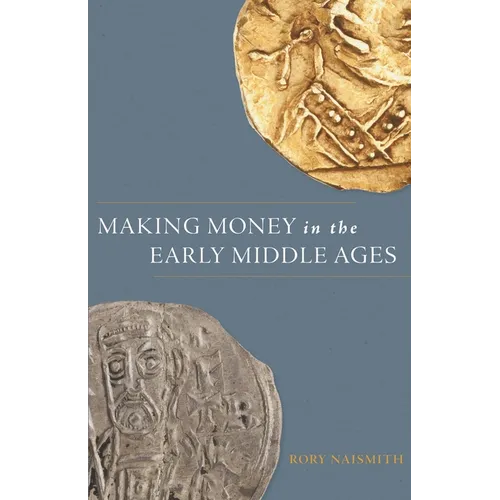
Product Description
by Rory Naismith (Author)
An examination of coined money and its significance to rulers, aristocrats and peasants in early medieval Europe
Between the end of the Roman Empire in the fifth century and the economic transformations of the twelfth, coined money in western Europe was scarce and high in value, difficult for the majority of the population to make use of. And yet, as Rory Naismith shows in this illuminating study, coined money was made and used throughout early medieval Europe. It was, he argues, a powerful tool for articulating people's place in economic and social structures and an important gauge for levels of economic complexity. Working from the premise that using coined money carried special significance when there was less of it around, Naismith uses detailed case studies from the Mediterranean and northern Europe to propose a new reading of early medieval money as a point of contact between economic, social, and institutional history. Naismith examines structural issues, including the mining and circulation of metal and the use of bullion and other commodities as money, and then offers a chronological account of monetary development, discussing the post-Roman period of gold coinage, the rise of the silver penny in the seventh century and the reconfiguration of elite power in relation to coinage in the tenth and eleventh centuries. In the process, he counters the conventional view of early medieval currency as the domain only of elite gift-givers and intrepid long-distance traders. Even when there were few coins in circulation, Naismith argues, the ways they were used--to give gifts, to pay rents, to spend at markets--have much to tell us.Author Biography
Rory Naismith is professor of early medieval English history at the University of Cambridge and a fellow of Corpus Christi College. He is the author of Early Medieval Britain, c. 500-1000, Citadel of the Saxons: The Rise of Early London, and Money and Power in Anglo-Saxon England: The Southern English Kingdoms, 757-865.
Number of Pages: 544
Dimensions: 1.21 x 9.21 x 6.14 IN
Publication Date: February 24, 2026