


Product Description
by James E. Katz (Author)
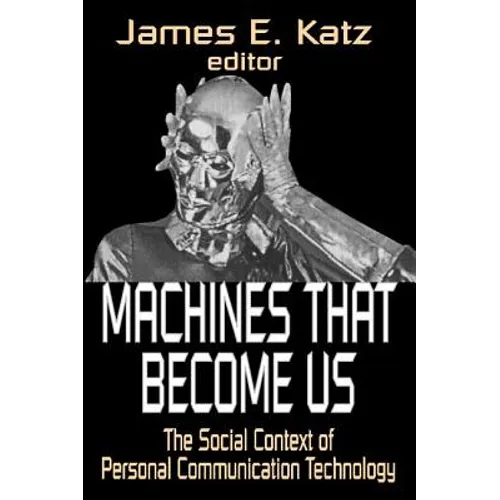
Social critics and artificial intelligence experts have long prophesized that computers and robots would soon relegate humans to the dustbin of history. Many among the general population seem to have shared this fear of a dehumanized future. But how are people in the twenty-first century actually reacting to the ever-expanding array of gadgets and networks at their disposal? Is computer anxiety a significant problem, paralyzing and terrorizing millions, or are ever-proliferating numbers of gadgets being enthusiastically embraced? Machines that Become Us explores the increasingly intimate relationship between people and their personal communication technologies.In the first book of its kind, internationally recognized scholars from the United States and Europe explore this topic. Among the technologies analyzed include the Internet, personal digital assistants (PDAs), mobile phones, networked homes, "smart" fabrics and wearable computers, interactive location badges, and implanted monitoring devices. The authors discuss critical policy issues, such as the problems of information resource access and equity, and the recently discovered "digital dropouts" phenomena.The use of the word "become" in the book's title has three different meanings. The first suggests how people use these technologies to broaden their abilities to communicate and to represent themselves to others. Thus the technologies "become" extensions and representatives of the communicators. A second sense of "become" applies to analysis of the way these technologies become physically integrated with the user's clothing and even their bodies. Finally, contributors examine fashion aspects and uses of these technologies, that is, how they are used in ways becoming to the wearer. The conclusions of many chapters are supported by data, including ethnographic observations, attitude surveys and case studies from the United States, Britain, France, Italy, Finland, and Norway. This approach is especially valuable given the dearth of empirical studies in a field that has been traditionally dominated by extrapolation and speculation, and that has focused on possible future states rather than analysis of current situations. Other chapters are integrative, seeking to advance emerging theoretical perspectives.This exciting volume generates new insights concerning the burgeoning electronic confusion that increasingly penetrates and blurs the boundaries of various spheres of life in modern society. Machines That Become Us will be of interest to students of communications and technology, sociologists, and social psychologists.



