


Product Description
by Ryan G. McClarren (Author)
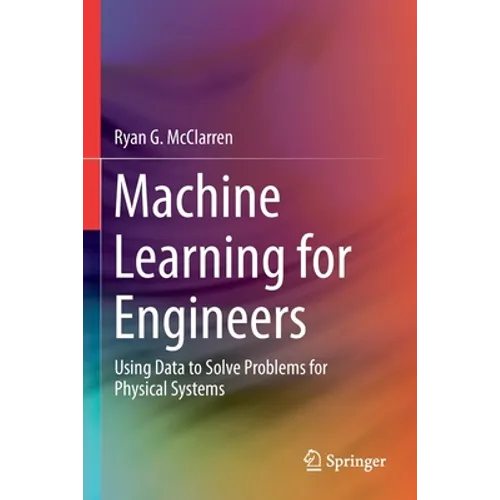
All engineers and applied scientists will need to harness the power of machine learning to solve the highly complex and data intensive problems now emerging. This text teaches state-of-the-art machine learning technologies to students and practicing engineers from the traditionally "analog" disciplines-mechanical, aerospace, chemical, nuclear, and civil. Dr. McClarren examines these technologies from an engineering perspective and illustrates their specific value to engineers by presenting concrete examples based on physical systems. The book proceeds from basic learning models to deep neural networks, gradually increasing readers' ability to apply modern machine learning techniques to their current work and to prepare them for future, as yet unknown, problems. Rather than taking a black box approach, the author teaches a broad range of techniques while conveying the kinds of problems best addressed by each. Examples and case studies in controls, dynamics, heat transfer, and other engineering applications are implemented in Python and the libraries scikit-learn and tensorflow, demonstrating how readers can apply the most up-to-date methods to their own problems. The book equally benefits undergraduate engineering students who wish to acquire the skills required by future employers, and practicing engineers who wish to expand and update their problem-solving toolkit.
Back Jacket
All engineers and applied scientists will need to harness the power of machine learning to solve the highly complex and data intensive problems now emerging. This text teaches state-of-the-art machine learning technologies to students and practicing engineers from the traditionally "analog" disciplines--mechanical, aerospace, chemical, nuclear, and civil. Dr. McClarren examines these technologies from an engineering perspective and illustrates their specific value to engineers by presenting concrete examples based on physical systems. The book proceeds from basic learning models to deep neural networks, gradually increasing readers' ability to apply modern machine learning techniques to their current work and to prepare them for future, as yet unknown, problems. Rather than taking a black box approach, the author teaches a broad range of techniques while conveying the kinds of problems best addressed by each. Examples and case studies in controls, dynamics, heat transfer, and other engineering applications are implemented in Python and the libraries scikit-learn and tensorflow, demonstrating how readers can apply the most up-to-date methods to their own problems. The book equally benefits undergraduate engineering students who wish to acquire the skills required by future employers, and practicing engineers who wish to expand and update their problem-solving toolkit.
Author Biography
Ryan McClarren, Associate Professor of Aerospace and Mechanical Engineering at the University of Notre Dame, has applied machine learning to understand, analyze, and optimize engineering systems throughout his academic career. He has authored numerous publications in refereed journals on machine learning, uncertainty quantification, and numerical methods, as well as two scientific texts: Uncertainty Quantification and Predictive Computational Science: A Foundation for Physical Scientists and Engineers and Computational Nuclear Engineering and Radiological Science Using Python. A well-known member of the computational engineering community, Dr. McClarren has won research awards from NSF, DOE, and three national labs. Prior to joining Notre Dame in 2017, he was Assistant Professor of Nuclear Engineering at Texas A&M University, and previously a research scientist at Los Alamos National Laboratory in the Computational Physics and Methods group. While an undergraduate at the University of Michigan he won three awards for creative writing.