


Product Description
by Eugene Demidenko (Author)
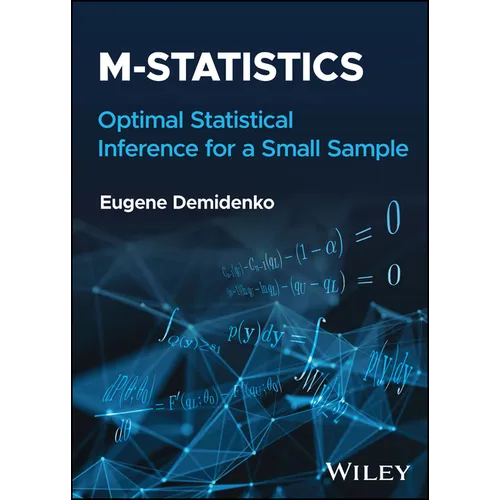
M-STATISTICS
A comprehensive resource providing new statistical methodologies and demonstrating how new approaches work for applications
M-statistics introduces a new approach to statistical inference, redesigning the fundamentals of statistics, and improving on the classical methods we already use. This book targets exact optimal statistical inference for a small sample under one methodological umbrella. Two competing approaches are offered: maximum concentration (MC) and mode (MO) statistics combined under one methodological umbrella, which is why the symbolic equation M=MC+MO. M-statistics defines an estimator as the limit point of the MC or MO exact optimal confidence interval when the confidence level approaches zero, the MC and MO estimator, respectively. Neither mean nor variance plays a role in M-statistics theory.
Novel statistical methodologies in the form of double-sided unbiased and short confidence intervals and tests apply to major statistical parameters:
- Exact statistical inference for small sample sizes is illustrated with effect size and coefficient of variation, the rate parameter of the Pareto distribution, two-sample statistical inference for normal variance, and the rate of exponential distributions.
- M-statistics is illustrated with discrete, binomial, and Poisson distributions. Novel estimators eliminate paradoxes with the classic unbiased estimators when the outcome is zero.
- Exact optimal statistical inference applies to correlation analysis including Pearson correlation, squared correlation coefficient, and coefficient of determination. New MC and MO estimators along with optimal statistical tests, accompanied by respective power functions, are developed.
- M-statistics is extended to the multidimensional parameter and illustrated with the simultaneous statistical inference for the mean and standard deviation, shape parameters of the beta distribution, the two-sample binomial distribution, and finally, nonlinear regression.
Our new developments are accompanied by respective algorithms and R codes, available at GitHub, and as such readily available for applications.
M-statistics is suitable for professionals and students alike. It is highly useful for theoretical statisticians and teachers, researchers, and data science analysts as an alternative to classical and approximate statistical inference.
Back Jacket
A comprehensive resource providing new statistical methodologies and demonstrating how new approaches work for applications
M-statistics introduces a new approach to statistical inference, redesigning the fundamentals of statistics, and improving on the classical methods we already use. This book targets exact optimal statistical inference for a small sample under one methodological umbrella. Two competing approaches are offered: maximum concentration (MC) and mode (MO) statistics combined under one methodological umbrella, which is why the symbolic equation M=MC+MO. M-statistics defines an estimator as the limit point of the MC or MO exact optimal confidence interval when the confidence level approaches zero, the MC and MO estimator, respectively. Neither mean nor variance plays a role in M-statistics theory.
Novel statistical methodologies in the form of double-sided unbiased and short confidence intervals and tests apply to major statistical parameters:
- Exact statistical inference for small sample sizes is illustrated with effect size and coefficient of variation, the rate parameter of the Pareto distribution, two-sample statistical inference for normal variance, and the rate of exponential distributions.
- M-statistics is illustrated with discrete, binomial, and Poisson distributions. Novel estimators eliminate paradoxes with the classic unbiased estimators when the outcome is zero.
- Exact optimal statistical inference applies to correlation analysis including Pearson correlation, squared correlation coefficient, and coefficient of determination. New MC and MO estimators along with optimal statistical tests, accompanied by respective power functions, are developed.
- M-statistics is extended to the multidimensional parameter and illustrated with the simultaneous statistical inference for the mean and standard deviation, shape parameters of the beta distribution, the two-sample binomial distribution, and finally, nonlinear regression.
Our new developments are accompanied by respective algorithms and R codes, available at GitHub, and as such readily available for applications.
M-statistics is suitable for professionals and students alike. It is highly useful for theoretical statisticians and teachers, researchers, and data science analysts as an alternative to classical and approximate statistical inference.
Author Biography
Eugene Demidenko is Professor of Biomedical Data Science at the Geisel School of Medicine and Mathematics at Dartmouth. He is a member of the American Statistical Association (ASA) and the Society of Industrial and Applied Mathematics (SIAM). In statistics, Professor Demidenko's research includes statistical methodology, mixed models, and nonlinear regression. In applied mathematics, he contributed to existence and uniqueness of global minimum, tumor regrowth theory, shape and image analysis, and solving ill-posed problems via mixed boundary partial differential equations. He is the author of two books published by Wiley in 2013 and 2020 "Mixed Models: Theory and Applications" and "Advanced Statistics with Applications in R." The latter book received a prestigious Ziegel Book Award in Statistics from Technometrics/ASA journal in 2022.


